Search
  • Visit
    • Get Tickets
    • Visit
    • Digital Guide
    • Frequently Asked Questions
    • Directions
    • Groups
    • Stay
    • Eat
    • Accessibility
    • Courtesy Code
    • On Campus
  • Events
  • Exhibitions
    • Current
    • Upcoming
    • Long-Term
    • Sound Art
    • Sol LeWitt
    • Anselm Kiefer
    • Past Exhibitions
  • Performing Arts
    • Upcoming Performances
    • MASS MoCA Records
    • Past Performances
  • Public Programs
    • Public Programs
    • Kidspace
    • Education
    • Teens
    • Camp Mass MoCA
  • Residencies
    • The Studios at MASS MoCA
    • Resident Artists
  • About
    • About
    • 2024–2030 Strategic Plan
    • Leadership
    • Commitment to Community Values, People & Place
    • History
    • Press Room
    • Jobs & Opportunities
    • Host Event / Rent Space
    • Land
    • Contact
  • Shop
    • Online Gift Shop
    • Research & Development Store
  • Join/Give
    • Give Now
    • Become a Member
    • Host Event / Rent Space
Search
START TYPING AND PRESS ENTER TO SEARCH
  • Visit
    • Get Tickets
    • Visit
    • Digital Guide
    • Frequently Asked Questions
    • Directions
    • Groups
    • Stay
    • Eat
    • Accessibility
    • Courtesy Code
    • On Campus
  • Events
  • Exhibitions
    • Current
    • Upcoming
    • Long-Term
    • Sound Art
    • Sol LeWitt
    • Anselm Kiefer
    • Past Exhibitions
  • Performing Arts
    • Upcoming Performances
    • MASS MoCA Records
    • Past Performances
  • Public Programs
    • Public Programs
    • Kidspace
    • Education
    • Teens
    • Camp Mass MoCA
  • Residencies
    • The Studios at MASS MoCA
    • Resident Artists
  • About
    • About
    • 2024–2030 Strategic Plan
    • Leadership
    • Commitment to Community Values, People & Place
    • History
    • Press Room
    • Jobs & Opportunities
    • Host Event / Rent Space
    • Land
    • Contact
  • Shop
    • Online Gift Shop
    • Research & Development Store
  • Join/Give
    • Give Now
    • Become a Member
    • Host Event / Rent Space

Artists’ Choice:
An Expanded Field of Photography

Artists Choice

For Immediate Release
April 8, 2015
Contact: Jodi Joseph
Director of Communications
413.664.4481 x8113
jjoseph@massmoca.org

Artists’ Choice: An Expanded Field of Photography

Liz Deschenes curates group exhibition featuring six artists with wide-ranging approaches to the field of photography

NORTH ADAMS, MASSACHUSETTS — In conjunction with her solo exhibition at MASS MoCA, Liz Deschenes curates a group exhibition featuring six artists whose work expands the field of photography. Dana Hoey, Miranda Lichtenstein, Craig Kalpakjian, Josh Tonsfeldt, Sara VanDerBeek, and Randy West will be represented by a combination of new and existing work (chosen, for the most part, by the artists themselves), which demonstrates the wide-ranging approaches to their art. Several of the featured artists make work that is considered photographic but is camera-less. For others, photography has laid the groundwork for the moving image or functions as a jumping-off point for sculptural investigations. With this small but diverse selection of artists, the exhibition provokes an open-ended dialogue on the state of photography as an increasingly diversified medium that intersects and informs other fields of art making. The exhibition opens with a reception on May 23, 2015.

Though the artists were selected for their individual strengths without any thematic restraints, commonalities emerge when their works are considered as a group. Each artist offers a new perspective on the fundamental properties and processes of photography — be they formal, mechanical, or conceptual. Light, depth, and pattern are examined and re-thought, as are support and frame. The medium’s traditional associations with mimetic representation, the male gaze, and reproducibility are also challenged. Many of the artists share Deschenes’ interest in architecture and the sculptural potential of photography — either creating an image of three-dimensional space, such as the work of Kalpakjian, or with the incorporation of sculpture into their practice, as in the works of both Tonsfeldt and VanDerBeek.

All of the artists engage with a number of pictorial traditions, influenced by predecessors ranging from Josef Albers and Sol LeWitt to Man Ray and László Moholy-Nagy. Like many of the artists in the exhibition, these antecedents worked in multiple mediums and pushed the boundaries of photography through their embrace of experimentation and new technologies. Finally, the featured artists frequently undermine the assumption that photography’s power lies in its ability to enhance visibility; instead their works often conceal, obscure, and confuse viewers’ perceptions of reality as well as expectations of image-making.

Dana Hoey
Dana Hoey’s photographs often address the problematics of representing the female figure. At MASS MoCA Hoey will debut Fighters (2014), a four-channel video installation, starring American kickboxer Alex Stagi and former professional Muay Thai fighter Kru Natalie Fuz, in three two-minute sparringrounds (staged with the help of fight choreographer Joe Falanga). Projected on four walls in a room that mimics the tight, square shape of a boxing ring, the video situates the viewer in the center of the fight. As the dizzying action travels across the walls, the viewer’s position embodies the shifting camera angles. Disrupting the conventional notion of objective perception, the moving camera and multiple, moving viewpoints will also convey the profound sensory complexity of the art of fighting. Hoey calls the work “a feminist proposition and an utterly pragmatic investigation of female power.”

Miranda Lichtenstein
Working with a wide range of subjects, Lichtenstein’s smart and seductive photographs bring a sense of wonder to the act of looking, transforming the real into something unexpected. The artist will present five works from her ongoing series “Screen Shadows” (begun 2010) as well as the video Danse Serpentine (doubled and refracted), 2010.  The “Screen Shadows” picture everyday objects from vases to kitchen gadgets, silhouetted and obscured by an array of papers, which act as a filter between the camera and object. The flattening effect of these paper screens, which blur foreground and background, creates enigmatic compositions which are often reminiscent of Man Ray’s experimental Rayographs. Lichtenstein looked directly to an early avant-garde work for inspiration with Danse Serpentine (doubled and refracted). In this video, she manipulates Louis Lumière’s hand-tinted 1896 film of the modern dance and lighting pioneer Loie Fuller whose improvised movements and rippling silk robes created a hypnotic synthesis of music, dance, and image. Lichtenstein recorded a projection of the original (sourced from YouTube) along with a second projection that was reflected off a mylar screen. The artist presents the video on a black curtain, which references the black theatrical fabric seen behind Fuller and further dissolves the dancer’s image into a ghostly reverie of light, color, and movement.

Craig Kalpakjian
Many of Craig Kalpakjian’s works present spatial conundrums, illusions of three dimensions which confuse inside and outside, artifice and reality. The two large ink-jet images in the exhibition, printed on a heavy photo paper, present a partial grid of squares that register between deep, dark black and modulated shades of grey.  In one of the works, two hazy, circular forms bring to mind the flash of a camera and also give the impression that behind the flat picture plane are two glowing lights and a boundless distance. The slightly puzzling geometries of the works grew out of two of the artist’s earlier series, one influenced by Josef Albers’ “Homage to the Square” and the other a group of digitally rendered images of shadowy, architectural spaces. Those enigmatic images of imagined corridors and corners devoid of people share with the new works a similarly unsettling sense of place.  Kalpakjian’s interest in Modernist architecture, minimalism, cinema, and the psychology of space intersect in these haunting and seductive works which seem to exist between multiple mediums. Printed on paper, attached to linen, and stretched like a canvas, the computer-generated works reference both painting and photography.

Josh Tonsfeldt
Josh Tonsfeldt’s practice is rooted in the everyday and the accumulation of small gestures that build a larger narrative. He moves easily between mediums without hierarchy, and his photographs, sculptures, and videos develop very naturally out of the images and materials of the artist’s daily life. His photographs have an intimate, almost unintentional quality, as well as a sensitivity to composition, line, color, and dimension. The spatial complexity apparent in many of his two-dimensional images and their references to screens, windows, reflections, and other filters translates easily to Tonsfeldt’s sculpture and his engagement with the space outside the photograph in general and with the spaces where the work is exhibited in particular. His installation at MASS MoCA will include a selection of photographic works and a sculpture built for the gallery which will play off those images and the materials involved in their production, storage, and presentation. Deconstructing those mechanisms, Tonsfeldt creates work which isolates, emphasizes, or disrupts both analog and digital components of the medium, including the frame, and materials such as printer inks, photographic papers, and the optical films used in LCD screens.

Sara VanDerBeek
Sara VanDerBeek has become known for her investigations of the relationship between photography and sculpture. Her early work featured photographs of assemblages of images which she culled from art books, magazines, and her family’s archive and which she constructed solely for the camera. Recently, VanDerBeek has been photographing cities which hold historic, personal, or political interest, including New Orleans, Detroit, Baltimore, Rome, and Rotterdam, whose spirit and texture she captures in her documentation of interstitial moments. At MASS MoCA VanDerBeek presents a group of new works, including photographs and two cast-concrete sculptures, which are influenced by the museum’s history as a producer of printed and dyed fabrics. Balanced Cloth, 2015, features an image of a layered, loose, grid-like mesh that the artist printed on fabric and wraps on an open frame reminiscent of a simple loom. Lace Shadows, 2015, captures shadows cast by a thin piece of tatting lace that the artist’s great-aunt made and preserved among only a few possessions when she immigrated to America from Denmark. Interested in women’s extensive history with textiles, VanDerBeek connects the lace shadows rising and fading from the dusky blue light in her images with the intermingling of past and present, a continuum connecting generations of women who have played important roles in the livelihood of their families, from Ancient Greece to the Industrial Revolution. Working simultaneously in two and three dimensions, VanDerBeek draws attention to the differences and intersections between the experience of image and object and what she has called “the transformative quality of photography… which can affect your sense of time, place, memory, and scale…”

Randy West
Randy West distills his subjects into minimal gestures of line, form, and texture. Providing unexpected representations of common objects ranging from bird nests to fabric to crumpled photographic paper, West often provides a deeper look at the details of his subjects while pushing their image to the edge of abstraction. At MASS MoCA West will exhibit Edge of the Cloud (2011), a grid of thirty ink-jet prints, which, like many of West’s works, were created by digitally scanning an object into the computer, eliminating the camera and traditional film processes. West scanned a single sheet of paper thirty times; each resulting print contains subtle shadows and marks caused by the handling of the paper over time, as well as a black border created by the scanner’s light bleeding around the edge of the paper. When viewed from a distance, the thirty images give the overall impression of a single, pale-gray cloud. The work brings up associations of the internet “cloud” as well as Alfred Stieglitz’s well-known series of cloud images form the 1920s, titled Equivalents, which, like West’s images, are often devoid of recognizable referents and walk the line between representation and abstraction. West further complicates this relationship by making images which have a 1:1 correlation between the original and its representation.

About the Artists
Born in San Francisco in 1966, Dana Hoey received a BA in philosophy from Wesleyan University in 1989 and a MFA in photography from Yale University in 1997. She has exhibited internationally at venues including the Liverpool Biennial, the San Francisco Museum of Modern Art; and P.S. 1, New York; and has had notable solo exhibitions at the University Art Museum at the University of Albany; the Center for Art, Design, and Visual Culture at the University of Maryland Baltimore County; and the Hirshhorn Museum and Sculpture Garden, Washington, DC. Her work is included in the collections of the Hirshhorn Museum, the Solomon R. Guggenheim Museum, New York; the San Francisco Museum of Modern Art; Pérez Art Museum Miami; and the Museum of Contemporary Art, Los Angeles, among others. Hoey is represented by Friedrich Petzel Gallery, New York.  She lives and works in upstate New York.

Miranda Lichtenstein was born in New York in 1969. She received a BA from Sarah Lawrence College in 1990 and an MFA from California Institute of the Arts in 1993. Her work has been exhibited at Hermès, New York; the Contemporary Austin (formerly AMOA-Arthouse); the Suburban, Oak Park, Illinois; the Solomon R. Guggenheim Museum, New York; the UCLA Hammer Museum, Los Angeles; and the Whitney Museum of American Art, New York. In 2002, she participated in the Residency Program and Fellowship at the Claude Monet Foundation in Giverny, France.  Her work can be found in the collections of the Hirshhorn Museum and Sculpture Garden, Washington, D.C.; the Solomon R. Guggenheim Museum and the New Museum of Contemporary Art in New York; and the Baltimore Museum of Art, among others. Lichtenstein is represented by Elizabeth Dee Gallery, New York. She currently lives and works in Brooklyn.

Born in 1961 in Huntington, New York, Craig Kalpakjian has a BA in art history from the University of Pennsylvania. His work has been shown at the Gebert Foundation in Rapperswil-Jona, Switzerland; the Metropolitan Museum of Art, New York; SculptureCenter, New York; the New Museum of Contemporary Art, New York; the Whitney Museum of American Art, New York; and the San Francisco Museum of Modern Art. His work is included in the collections of the Metropolitan Museum of Art, the Whitney Museum of American Art, the New Museum of Contemporary Art, the San Francisco Museum of Modern Art, and the Centre Pompidou in Paris, among others. Kalpakjian currently lives and works in New York City.

Josh Tonsfeldt was born in Independence, Missouri, in 1979. He earned a BA from SUNY Purchase College in 2004 and an MFA from Columbia University in 2007. He has exhibited widely over the past decade. He recently completed projects at Rowhouse Projects in Baltimore, Maryland, and Galleria d’Arte Moderna e Contemporanea di Bergamo, Bergamo, Italy. His work has also been seen at the Elizabeth Foundation, New York; Serpentine Galleries, London; White Columns, New York; Sculpture Center, New York; and The Kitchen, New York. Tonsfeldt is represented by Simon Preston Gallery, New York. He currently lives and works in New York City.

Sara VanDerBeek, born in Baltimore, Maryland, in 1976, earned a BFA from the Cooper Union in 1998.  Recent projects include a solo exhibition at Cleveland Museum of Contemporary Art, and participation in the 12th Bienal de Cuenca, Ecuador. Her work has also been exhibited at the UCLA Hammer Museum, Los Angeles; the Whitney Museum of American Art, New York; the Museum of Fine Arts, Houston; and the Museum of Modern Art, New York. Her work is included in the collections of the Solomon R. Guggenheim Museum, the Museum of Modern Art, the Whitney Museum of American Art, New York, the Hirshhorn Museum and Sculpture Garden, Washington, DC; the Los Angeles County Museum of Art, and the Museum of Contemporary Art, Los Angeles, among others. Forthcoming projects include solo exhibitions at the Museum Boijmans Van Beuningen, Rotterdam and the Baltimore Museum of Art. VanDerBeek is represented by the approach, London; Altman Siegel Gallery in San Francisco; and Metro Pictures in New York. She currently lives and works in New York City.

Born in Indianapolis in 1960, Randy West received an MFA from the California Institute of the Arts in Valencia in 1986. His work has been exhibited at the George Eastman House, Rochester; Cornell Fine Arts Museum, Rollins College, Winter Park, Florida; Aperture Foundation, New York; Queens Museum, New York; Houston Center for Photography, Houston; The International Center of Photography, New York; and the Museum of Contemporary Art, San Diego. His work is included in the collections of the Museum of Fine Arts, Houston; Center for Creative Photography, University of Arizona; US Federal Reserve, Washington, D.C., and the Aaron Siskind Foundation, New York, among others. West is represented by Bruce Silverstein Gallery, New York. West splits his time between New York City and the Catskills.

Images
A collection of high-resolution images is available here: bit.ly/1OBdOu7.

About MASS MoCA
MASS MoCA is one of the world’s liveliest (and largest) centers for making and enjoying today’s most important art, music, dance, theater, film, and video. Hundreds of works of visual and performing art have been created on its 19th-century factory campus during fabrication and rehearsal residencies, making MASS MoCA among the most productive sites in the country for the creation and presentation of new art. More platform than box, MASS MoCA strives to bring to its audiences art experiences that are fresh, engaging, and transformative.

MASS MoCA’s galleries are open 11am to 5pm every day except Tuesdays. The Hall Art Foundation’s Anselm Kiefer reopens April 18, 2015. Gallery admission is $18 for adults, $16 for veterans and seniors, $12 for students, $8 for children 6 to 16, and free for children 5 and under. Members are admitted free year-round. For additional information, call 413.662.2111 x1 or visit massmoca.org.
Download the Artists Choice press release

Francesco Clemente

For Immediate Release
19 March 2015
Contact: Jodi Joseph
Director of Communications
413.664.4481 x8113
jjoseph@massmoca.org

Francesco Clemente: Encampment


NORTH ADAMS, MASSACHUSETTS — “I’m told I am a nomadic artist,” artist Francesco Clemente once dryly noted. In Encampment — a multi-part 30,000 square foot installation occupying MASS MoCA’s largest gallery — Clemente’s transitory experience of changing geographies, diverse cultural climates, and indeed consciousness itself infuses his imagery and art with a particularly rich range of references and meaning. For the past three decades Clemente has traveled often, dividing his work and primary residences between Varanasi, India, and New York. Informed by the logistical realities and production opportunities of making art in wildly disparate locations, his aesthetic investigation of states of flux delves into the nature of passage itself. “I believe in this movement of generating and dissolving, and regenerating and dissolving again — this is a technique for the mind to become and remain awake,” Clemente explains. Passages between bodily pleasure and changing spiritual states, between acts of destruction and creation, and between the seen and unseen are all at the heart of Encampment, opening at MASS MoCA in North Adams on June 13, 2015, and remaining on view through early January 2016.

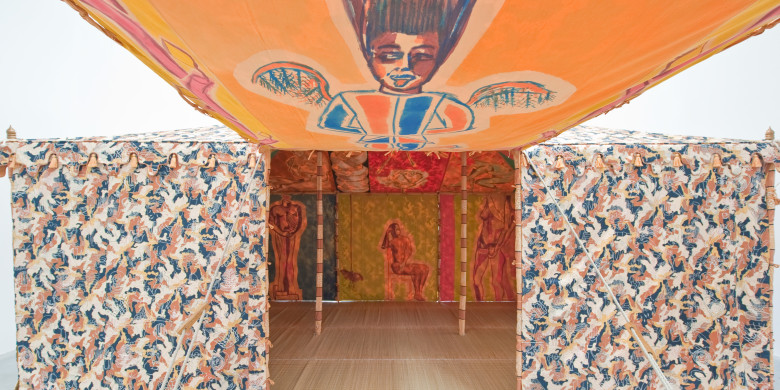
The show’s centerpiece — gathered at MASS MoCA for the first time as a complete ensemble — is a suite of six painted canvas tents, which, as Clemente noted, “were generated by reflection on my own life, and my own needs; it was as if I didn’t have a home, but wanted one.” Created over the course of three years from 2012 through 2014, in collaboration with a community of artisans in Rajasthan, India, the large 2-pole structures (each measuring some 10’ x 18’ x 12’ high) transform MASS MoCA’s signature Building 5 gallery into a kind of tent village, inhabited by painted human figures both supine and in motion, and emblematic symbols and signs both obvious and arcane. Secured in place by ropes and special cast-iron weights, the exteriors of the large bamboo and fabric tents are richly decorated with hand-printed woodblock designs, carved after drawings by Clemente. The patterns recall the camouflaging on the uniforms and gear of the Indian Army in Rajasthan — the visual resonance of which is heightened by the region’s complex social, political, and military relationship with Pakistan, whose border it shares. Closer inspection of the camouflage patterns reveals esoteric texts, embedded icons, human silhouettes, and other subtle signs, all intricately outlined with hand-embroidered gold-colored thread. Inside the tents, walls, ceilings, and entryways are awash in richly toned jewel-like paintings. Depictions of love and carnal desire are juxtaposed with trompe l’oeil paintings of framed portraits of Clemente, for example, in which the artist’s arm and hand reach through the frame, grasping towards viewers. Implicating our very presence in the museum, Clemente draws visual parallels between erotic voyeurism and the spectatorial enjoyment of art.

As an installation, the tents combine to create a beautiful world of color and strangely alluring hospitality. Passing by and through the tents, the viewer is led to a darkened, theatrically lit space, where Clemente presents four large-scale sculptures. Resembling altars or guideposts that at first appear to be fabricated of wood and other organic materials, the vertical sculptures are, in fact, built and cast from aluminum. The four works — Earth, Moon, Sun, and Hunger — incorporate both traditional forms and references to contemporary life: in Moon, for example, a bronze-colored stereo sits atop a metal work box balanced precariously atop a base made from silvery branches. Taken together, the works suggest both a maker and viewer in states of transitory suspension, caught, perhaps, between a life lived directly, without mediation, and reality experienced one step removed, as an observer, or as a consumer of culture. Quoting Guy Debord’s seminal text, The Society of the Spectacle, the flag that hangs from the top of Hunger is embroidered with the words “the spectator feels at home nowhere because the spectacle is everywhere.”

In a third mezzanine gallery overlooking the tent encampment, the exhibition includes a stunning new suite of 19 erotically charged paintings, rendered in bright washes of watercolor and exquisitely detailed brushwork in solid body ink. Drawing on the tradition and craft of Mughal miniature painting, the watercolors combine decorative motifs with dreamy imagery that shifts between abstraction and figure painting. Sharply juxtaposing abstract interludes with scenes of love and intense desire, the paintings layer textures and color forms in ways that appear almost collage-like in their spatial complexity. The finely detailed, hand-painted miniature patterns in gouache add an unusual visual register to the transparent watercolors, layering silhouetted bodies in sinewy vines and other organic shapes, and confusing traditional distinctions between figure and ground.  In India, Clemente “found a place that was utterly contemporary and with the same vitality and drive that I knew of in the West, but in completely alternative terms.” In this new series of paintings, he draws on Indian and Western European traditions to create a hybrid visual language with which to relate intimate tales of sensual and spiritual encounter.

Timing Detail:
The exhibition opens to the public at 11am, Saturday, June 13. There will be a reception for museum members (and for the public with admission tickets) on Friday, June 12, at 5:30pm. Note that the museum shifts to extended summer hours, on June 26. See below for more information.

About the Artist
Francesco Clemente was born in Italy, and lives and works in Varanasi, India, and New York, New York. Recent solo exhibitions include the Rubin Museum of Art, New York; Schirn Kunsthalle, Frankfurt; Uffizi Gallery, Florence; Reykjavik Art Museum, Reykjavik; Solomon R. Guggenheim Museum, New York; Musée National d’Art Moderne, Centre Georges Pompidou, Paris; SFMoMA, San Francisco; Dia Art Foundation, New York; The Museum of Modern Art, New York; Nationalgalerie, Berlin; and Stedelijk Museum, Amsterdam. Clemente is a member of the American Academy of Arts and Letters.

Images
A collection of high-resolution images is available here: bit.ly/1BWZndk. 

About MASS MoCA
MASS MoCA is one of the world’s liveliest (and largest) centers for making and enjoying today’s most important art, music, dance, theater, film, and video. Hundreds of works of visual and performing art have been created on its 19th-century factory campus during fabrication and rehearsal residencies, making MASS MoCA among the most productive sites in the country for the creation and presentation of new art. More platform than box, MASS MoCA strives to bring to its audiences art experiences that are fresh, engaging, and transformative.

MASS MoCA’s galleries are open 11am to 5pm every day except Tuesdays. In the summer months, the galleries are open 10am to 6pm every day. The Hall Art Foundation’s Anselm Kiefer exhibition is open seasonally, reopening on April 18. Gallery admission is $18 for adults, $16 for veterans and seniors, $12 for students, $8 for children 6 to 16, and free for children 5 and under. Members are admitted free year-round. For additional information, call 413.662.2111 x1 or visit massmoca.org.
Download the Francesco Clemente: Encampment press release

Aaron Johnson

For Immediate Release
3 March 2015
Contact: Jodi Joseph
Director of Communications
413.664.4481 x8113
jjoseph@massmoca.org

Walk in My Shoes

Kidspace exhibition features Jamie Diamond, Jesse Fleming, and Aaron Johnson

NORTH ADAMS, MASSACHUSETTS — Beginning this June, Kidspace at MASS MoCA kicks off four years of related exhibitions, organized under a single narrative and developmental arc. The series of experiential exhibitions expands the traditional process of problem-solving by involving three key habits of mind: empathy, optimism, and courage. In the first year, Walk in My Shoes (June 20, 2015 – May 23, 2016) features artwork chosen to activate empathic responses and amplify awareness of one’s feelings and compassion towards others. In year two, Here Comes the Sun (June 17, 2016 – May 22, 2017), a group costume exhibition, uses celebratory themes and expressions of joy that lead to increased optimism. Year three features Out of the Box (June 17, 2017 – May 21, 2018), an exhibition in which an artist converts the Kidspace gallery into an experimental playground for courageous artistic explorations. During the fourth year, From the Mouths of Babes (June 16, 2018 – May 20, 2019), 6th graders from Kidspace partner schools will present an arts-based solution to a societal issue of their choosing. Working with an artist, museum educator, art therapist, and social worker, they will conceptualize and execute an artistic response to the problem. The four-year exhibition project will be accompanied by an evaluation that documents: 1) confidence in the three aforementioned habits of mind; 2) openness to engaging in a complicated problem-solving process; and 3) application of problem-solving social issues through art.

The first exhibition project Walk in My Shoes opens in the Kidspace gallery on June 20, 2015, and features paintings, videos, and photographs by Jamie Diamond, Jesse Fleming, and Aaron Johnson. Jamie Diamond presents seemingly realistic images in her family portrait series, which in fact are artificial relationships that she constructs among strangers; from a quick glance, one might assume a strong familial bond. In another project, Diamond videotaped fraternity brothers posing for two minutes. Without background knowledge, the videos pose such questions as, “Who are these boys?” and “Why are they smiling?” A viewer makes assumptions to answer these questions, but then forms new ideas when the answers are revealed. Feelings of empathy change, depending on what is known. Additionally, Diamond explores how empathy and compassion are projected towards inanimate objects, particularly dolls. She will create a doll specifically for the exhibition, which will be presented alongside close-up photographs of similar dolls displaying a range of facial expressions. Included in the exhibition is an interactive station in which children can role-play different identities for a photo booth.

Jesse Fleming shows Mirror Mirror, a film of two participants who attempt to sync with each other through a simple call-and-response activity in which they randomly list colors or numbers. The exercise creates a mysteriously observable connection between the partners. Viewers become active participants in the process when they sense that the partners are successfully in tune, and remain empathetically connected as the video subjects stay focused on each other. Fleming will also create an interactive experiment in which visitors are able to replicate the exercise on site, an act that, according to the artist, completes the work by visitors having a direct experience with it.

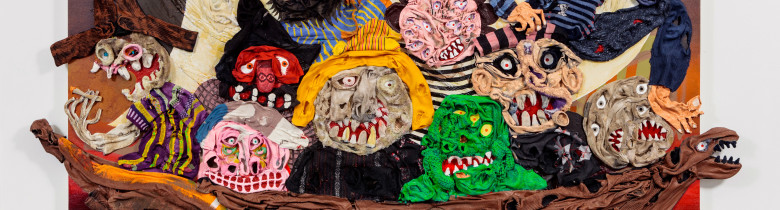
Artist Aaron Johnson pairs socks with paint, forming playful, yet sinister monster-like figures in his eerie compositions. Viewers may form immediate reactions to the works, similar to the way people often rush to judge others from a superficial perspective. Closer observation, however, may yield different and perhaps more empathetic responses. Johnson distorts and disfigures the human form to create fantastical rather than realistic images, presenting a light-hearted opportunity to explore the visual mechanisms by which impressions of others are formed.

Walk in My Shoes opens on June 20, 2015, with an opening reception from 11am to 1pm. Curator Laura Thompson speaks at 11:15am about the four-year project and, more specifically, about Walk in My Shoes; Jesse Fleming talks about his work at 11:30am; and refreshments, art-making, and tours of the new exhibition are available all day. Also opening on June 20 is Ran Hwang: Untethered on the second floor of the Hunter hallway, adjacent to Kidspace. Patrons may meet this famed button-bird artist of Kidspace’s Freedom: Just Another Word For (2013), who has made a new, 140-foot-long site-specific bead and string installation of birds.

About the Artists
Jamie Diamond received her MFA from the University of Pennsylvania in 2008, and her BA from the University of Wisconsin in 2005. Her work is grounded in photography, questioning notions of identity, intimacy, and reality. Her interests include the dialogue surrounding representation and photography’s relationship to truth. She has exhibited her work in solo and group exhibitions nationally and internationally, including at Galerie Frank Pages, Geneva, Switzerland; AJL Gallery, Berlin, Germany; Galerie Jan Dhaese, Gent, Belgium; Ramis Barquet, New York; Radiator Arts, Long Island City; The Bronx Museum; P339 Gallery, Brooklyn; Samson Projects, Boston; Mana Glass Gallery, Jersey City; Kurant, Tromsø, Norway; Projects Gallery, Philadelphia; and Icebox Project Space, Philadelphia. Her work has appeared in numerous publications including The Philosophy of Photography Journal, The New York Times, The Philadelphia Inquirer, Hyperallergic, Vanity Fair, The Art Blog, and Phaidon. Diamond is a recipient of the Toby Devan Lewis Fellowship Award (2008) and the NYFA Fellowship Award in Photography (2014), was an artist in residence at Mana Residency (2014), The Bronx Museum (2014), Lower Manhattan Cultural Council (LMCC) Swing Space (2013), and LMCC Work Space (2008-2009), and was a visiting artist at New York University (2009). Diamond currently lives and works in New York City and teaches photography at the University of Pennsylvania and the International Center of Photography.

Jesse Fleming designs his work to elicit collective versus independent self, empathy, attunement, compassion, and group potential experiences. He is investigating a quality of non-self-referential experience through media and technologies that help lower the perceived boundary between self and other. Fleming has exhibited nationally and internationally in Los Angeles, New York, Austin, London, and Barcelona; has created films for the Museum of Modern Art, New York, the Guggenheim Museum, New York, The Getty Museum, Los Angeles, and The Museum of Contemporary Art Los Angeles; and has exhibited at 356 Mission Road, Los Angeles, the Hammer Museum, Los Angeles, The University of Texas at Austin, and Borusan Contemporary, Istanbul, Turkey. Fueling his media works as a mindfulness practitioner, Fleming has a decade of meditation training and practice in ancient contemplative techniques and secular mindfulness with a certificate in Mindfulness Facilitation from UCLA’s Mindful Awareness Research Center at The Semel Institute for Neuroscience and Human Behavior. His work is in the permanent collection of the Whitney Museum of American Art, New York, and Borusan Contemporary.

Aaron Johnson is an artist interested in the grotesque and the absurd as channeled through his radically innovative approaches to painting. He has lived and worked in Brooklyn, New York, since 1999, and holds an MFA from Hunter College (2005). His work has been included in museum exhibitions at The Museum of Modern Art, New York; the Hudson Valley Center for Contemporary Art, Peekskill, NY; The Knoxville Museum of Art, Knoxville, Tennessee; and the Katzen Arts Center at American University. His work has been exhibited at galleries internationally, including Stux Gallery, New York; Marlborough Gallery, New York; Irvine Contemporary, Washington, DC; Galleri Brandstrup, Oslo, Norway; Gallery Poulsen, Copenhagen, Denmark; and MiTO Contemporary Art Gallery, Barcelona, Spain. He is the recipient of awards including The MacDowell Colony Fellowship, The Corporation of Yaddo residency, and The Marie Walsh Sharpe Art Foundation Space Program residency. Johnson has lectured at many universities and institutions including The Museum of Modern Art, The Rubin Museum of Art, and Lehman College. He has taught art to children through organizations such as Studio in a School. Johnson’s work has been reviewed in numerous publications, including The New York Times, The Huffington Post, The Village Voice, ARTnews, and ArtForum. Roberta Smith in The New York Times describes Johnson’s paintings as “works that are visceral, beautiful and flamboyantly timely, which is saying a lot.”

Related Programming
During the school year, Kidspace continues its 15-year partnership with the North Adams Public Schools and the North Berkshire School Union. Over 1,400 students and teachers will participate in group visits; Art Assembly performances; artist residencies with Diamond, Fleming, and Johnson; and professional development for teachers. Additional programs will include talks with authors and educators about the theme of empathy, to be announced in the fall.

Sponsorship
Kidspace at MASS MoCA is a child-centered art gallery and hands-on studio that presents exhibitions and educational experiences in collaboration with leading artists. Education at MASS MoCA is made possible in part by the Institute of Museum and Library Services. Additional support is provided by the Brownrigg Charitable Trust, the Milton and Dorothy Sarnoff Raymond Foundation, and the Alice Shaver Foundation, all in memory of Sandy and Lynn Laitman; John Hancock; the Amelia Peabody Charitable Foundation; Holly Swett; the Massachusetts Cultural Council; the Xeric Foundation; the C & P Buttenwieser Foundation; the Berkshire Bank Foundation – Legacy Region; Price Chopper’s Golub Foundation; the Gateway Fund and the William and Margery Barrett Fund of the Berkshire Taconic Community Foundation; and an anonymous donor.

Images
A collection of high-resolution images is available here: bit.ly/1MNbS0P.

Kidspace Public Hours
Free public hours are offered during the school year every day except Tuesdays, from 11am to 5pm, with art-making on the weekends and during school holidays. During the summer (July-August) the gallery is open every day, including Tuesdays, with art-making from 10am to 6pm.

About MASS MoCA
MASS MoCA is one of the world’s liveliest (and largest) centers for making and enjoying today’s most important art, music, dance, theater, film, and video. Hundreds of works of visual and performing art have been created on its 19th-century factory campus during fabrication and rehearsal residencies, making MASS MoCA among the most productive sites in the country for the creation and presentation of new art. More platform than box, MASS MoCA strives to bring to its audiences art experiences that are fresh, engaging, and transformative.

MASS MoCA’s galleries are open 11am to 5pm every day except Tuesdays. The Hall Art Foundation’s Anselm Kiefer exhibition reopens on April 15, 2015. Gallery admission is $18 for adults, $16 for veterans and seniors, $12 for students, $8 for children 6 to 16, and free for children 5 and under. Members are admitted free year-round. For additional information, call 413.662.2111 x1 or visit massmoca.org.
 

Download the Walk In My Shoes press release


For Immediate Release
18 February 2015
Contact: Jodi Joseph
Director of Communications
413.664.4481 x8113
jjoseph@massmoca.org

Clifford Ross: Landscape Seen & Imagined

Extreme scale, super high-resolution photography, augmented reality, immersive video, and music probe the junction of nature and abstraction

NORTH ADAMS, MASSACHUSETTS — In this major mid-career museum survey, Landscape Seen & Imagined documents Clifford Ross’s longstanding project to reconcile realism and abstraction. The exhibition takes place throughout two buildings, six galleries, and an exterior performing arts courtyard. Among other works, the exhibition includes a 24’ high x 114’ long photograph on raw wood that spans the length of MASS MoCA’s tallest gallery and an immersive installation of animated video on twelve separate 24’ high screens. Ross’s hyper-detailed photographs of hurricane waves and mountains are included along with a new “invisible art” project featuring animated virtual elements only accessible by means of the viewer’s smartphone. The exhibition opens on May 23, 2015, with a reception for the artist, followed by a second phase beginning June 26, 2015, which launches the immersive outdoor video installation and the augmented reality experience.

“While this show is about acute observation and the leaps into abstraction that can happen with close viewing, it is also about the divergence between the world as we see it and as we imagine it might be,” notes MASS MoCA Director Joseph Thompson.

Large-scale high-resolution photographic works are the source material and centerpiece of Ross’s exhibition. For his Hurricane series, Ross wades into the surf while tethered to land, capturing vivid images of ocean waves during severe coastal storms. For his Mountain series — which takes Mount Sopris near Aspen, Colorado, as its subject — Ross invented and patented his so-called R1 camera, using it to create some of the highest-resolution single-shot landscape photographs ever produced.

To reach what Ross calls “the essence of my subject,” the artist makes imaginative and inventive use of both traditional and new media, including printing on unexpected surfaces, ambitious computer rendering techniques, and startling, architecturally scaled applications of augmented-reality software. Equal emphasis is given to multimedia works that embrace unusual forms of abstraction drawn from minutely detailed observations of nature.

In the museum’s tallest gallery, for example, Ross’s Harmoniums — small details extracted from the large Mount Sopris image and then accentuated with bright hues — are made visible to visitors through their smartphones. Juxtaposed against the stark power of the mountainscape — which is rendered as a negative in black ink — the Harmoniums infuse the viewing experience with color and interactive movement.

The exhibition also includes a new series of video works entitled Digital Hurricane Waves, shown in a minimally improved, 12,000 square-foot space never before utilized at MASS MoCA. Within a loft-like trussed gallery adjacent to the space containing the first American exhibition of Ross’s new large-scale Hurricane prints, computer-generated renderings of complex fluid dynamics are projected onto large screens, which combine to form what the artist calls a Wave Cathedral.

Deeply anchored in tradition, Ross’s radical and technologically advanced Mountain photographs are influenced by his fascination with Albert Bierstadt’s and Frederic Church’s iconic views of the American West, which he studied while at Yale University and which he has described as “my salvation from the certain death of a narrow aesthetic inheritance — namely Clement Greenberg’s formalism and the Color Field tradition I was born into.” Ross embraces Turner, Courbet, Hokusai, and 19th-century photographer Gustave Le Gray as predecessors to his Hurricane series. His interest in the interplay of realism and abstraction — the seen and imagined — relies on sources that range from Rembrandt to Pollock, Cezanne to Northern Sung painter Fan Kuan.

About the Artist
Clifford Ross (born in 1952 in New York City) earned a B.A. in art and art history from Yale University in 1974. Following an early career in painting and sculpture, Ross began his photographic work in 1994.  His milestone Hurricane series was commenced in 1996. Ross’s recent collaborations include a multimedia installation with Pan Gongkai, president of the Central Academy of Fine Arts in Beijing, and a 3.5 ton, 28′ x 28′ stained glass wall with architects Mack Scogin and Merrill Elam for the U.S. Federal Courthouse in Austin, Texas. Ross is a visiting artist with the NYU Tisch School of the Arts’ Interactive Telecommunications Program, contributing editor for BOMB and Blind Spot magazines, and editor of Abstract Expressionism: Creators and Critics (Abrams), and serves as Chair of the Helen Frankenthaler Foundation. His work has been widely exhibited in galleries and museums in the United States, as well as in Europe, Brazil, and China, and can be found in numerous public collections, including the Museum of Modern Art, the Metropolitan Museum of Art, and the Solomon R. Guggenheim Museum in New York City; the J. Paul Getty Museum, Los Angeles; and the Museum of Fine Arts, Houston.

Catalogue
With introductions by MASS MoCA Director Joseph Thompson, two fully illustrated companion volumes accompany the show, published by The MIT Press: Hurricane Waves and the broader narrative of Seen & Imagined.

The first book, devoted to Hurricanes, is edited by Jay Clarke, curator of prints, drawings, and photographs at the Clark Art Institute, and includes authors’ essays by Phong Bui, curator, art critic, editor, and publisher of the Brooklyn Rail; Ms. Clarke; Orville Schell, environmentalist, art critic, contributing author to The New Yorker and director of the U.S.-China Institute at the Asia Society, New York; and the first part of a two-part interview with the artist by Mr. Schell.

The second book includes texts by David Anfam, author of the Mark Rothko catalogue raisonné and the forthcoming Clyfford Still catalogue raisonné and senior consulting curator, Clyfford Still Museum; Quentin Bajac, chief curator of photography, the Museum of Modern Art, New York; Arthur C. Danto, art critic for The Nation and Johnsonian Professor Emeritus of Philosophy, Columbia University; Jack Flam, art historian, Distinguished Professor of Art and Art History at Brooklyn College, and The Graduate Center of the City University of New York; Nicholas Negroponte, Chairman Emeritus and Founder of the MIT Media Lab and author of Being Digital; and Jock Reynolds, director of the Yale University Art Gallery, New Haven, Connecticut; and the second part of a two-part interview with the artist by Mr. Schell.

Images
A collection of high-resolution images is available here: bit.ly/1zw1aBd.

About MASS MoCA
MASS MoCA is one of the world’s liveliest (and largest) centers for making and enjoying today’s most important art, music, dance, theater, film, and video. Hundreds of works of visual and performing art have been created on its 19th-century factory campus during fabrication and rehearsal residencies, making MASS MoCA among the most productive sites in the country for the creation and presentation of new art. More platform than box, MASS MoCA strives to bring to its audiences art experiences that are fresh, engaging, and transformative.

MASS MoCA’s galleries are open 11am to 5pm every day except Tuesdays. In the summer months, the galleries are open 10am to 6pm every day. The Hall Art Foundation’s Anselm Kiefer exhibition is open seasonally, reopening in May 2015. Gallery admission is $18 for adults, $16 for veterans and seniors, $12 for students, $8 for children 6 to 16, and free for children 5 and under. Members are admitted free year-round. For additional information, call 413.662.2111 x1 or visit massmoca.org.
#cliffordross

#massmoca

Download the Clifford Ross: Landscape Seen & Imagined press release

Barbara Takenaga

For Immediate Release
13 February 2015
Contact: Jodi Joseph
Director of Communications
413.664.4481 x8113
jjoseph@massmoca.org

Barbara Takenaga: Nebraska

Painter translates exuberant work to large-scale mural installation

NORTH ADAMS, MASSACHUSETTS — Painter Barbara Takenaga creates a new work of an unprecedented scale for a 100’ wall in the Hunter Center lobby at MASS MoCA. Known for her labor-intensive, exuberant abstractions composed of matrix-like, swirling patterns of dots, Takenaga translates her meticulous, handcrafted, easel-sized work to wallpaper in this large-scale commission. The mural features a new image from her series, Nebraska Paintings, a body of work that moves closer to the representational imagery only implied in earlier pieces, but which captures the wide open spaces and big sky of the artist’s native state. The work will be on view at MASS MoCA beginning July 12, 2015.

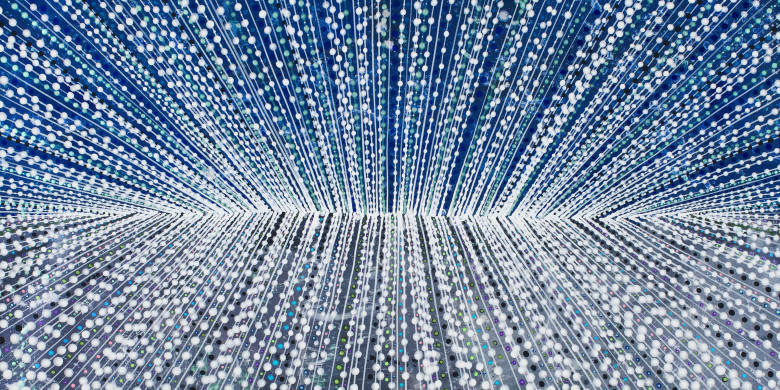
At MASS MoCA, Takenaga’s pared-down landscape of earth and atmosphere is painted in grays and muted tones, which the artist likens to the quality of light at dusk. In her words, the moody palette, punctuated with the artist’s signature burst of high color, conveys “the ‘violet hour’ of in-between time, when the land and sky start to blur.” A horizon line, situated high in Takenaga’s composition, places the viewers’ perspective floating above the ground, suggesting that an immense expanse of plain stretches out in front of them. Repeated lines of white dots radiate out in all directions from an implied vanishing point on the horizon line to suggest blooming crops, a snowy blizzard, or a star-filled sky. The single image is repeated twelve times along the length of the wall, with the composition’s receding lines and diminishing dots of classical one-point perspective alternately moving backward toward the horizon and forward toward the viewer. The long horizon is regularly interrupted by a diamond-like shape formed by the intersection of lines at the seams between each image. As viewers walk the length of the wall, the chain of images functions like a series of film stills, implying movement and the rhythm of time. The result is a tension-filled composition that emphasizes both the flat surface of the wall and an illusion of depth. Adding even more dimension to the work, as well as a sense of the artist’s hand to the digitally reproduced image, Takenaga will apply iridescent paint to the wallpaper surface.

Describing Takenaga’s paintings as both “hallucinogenic” and “sternly disciplined,” writer Nancy Princenthal aptly describes the Nebraska Paintings: “It would be misleading to overstate the figurative suggestions of these paintings, or their emotional weight. Many present a sleek seductiveness that combines acid-trip visual plentitude with James Bond cool. But given a minute, the imagery grows more complex. Takenaga’s work explores the minimum requirements for evoking astral space, or snow over the plains, or an uncharted sea. And it demonstrates the many pleasures, not excluding the optical, that such evocations provide.”

About the Artist
Barbara Takenaga was born in North Platte, Nebraska, and has a M.F.A. from the University of Colorado, Boulder. She has had solo exhibitions at the Colorado University Museum, University of Colorado, Boulder; Brattleboro Art Museum, Brattleboro, Vermont; McKinney Avenue Contemporary, Dallas; Art in General, New York; and the Williams College Museum of Art, among other museums and galleries. Takenaga’s work has also been exhibited in group exhibitions at the Pennsylvania Academy of the Fine Arts, Philadelphia; San Antonio Museum of Art, Texas; Henry Art Gallery, Seattle; American Academy of Arts & Letters, New York; Bell Gallery, Brown University, Providence, Rhode Island; deCordova Sculpture Park and Museum, Lincoln, Massachusetts; Tang Teaching Museum and Art Gallery, Skidmore College, Saratoga Springs, New York; Museum of Contemporary Art, Denver; and the Asia Society, New York. In 2013 Takenaga was elected National Academician of the National Academy, New York. Her work can be found in numerous public and private collections, including the Pennsylvania Academy of the Fine Arts; Crocker Art Museum, Sacramento, California; Neuberger Museum of Art, Purchase, New York; the San Jose Museum; Library of Congress, Washington, D.C.; and the Frederick R. Weisman Art Foundation, Los Angeles; among others. Takenaga is the Mary A. & William Wirt Warren Professor of Art at Williams College, Williamstown, Massachusetts. She is represented by Gregory Lind Gallery, San Francisco; and DC Moore Gallery, New York. Takenaga lives and works in New York City and Williamstown, Massachusetts.

Images
A collection of high-resolution images is available here: bit.ly/1vIqrxA.

About MASS MoCA
MASS MoCA is one of the world’s liveliest (and largest) centers for making and enjoying today’s most important art, music, dance, theater, film, and video. Hundreds of works of visual and performing art have been created on its 19th-century factory campus during fabrication and rehearsal residencies, making MASS MoCA among the most productive sites in the country for the creation and presentation of new art. More platform than box, MASS MoCA strives to bring to its audiences art experiences that are fresh, engaging, and transformative.

MASS MoCA’s galleries are open 11am to 5pm every day except Tuesdays. In the summer months, the galleries are open 10am to 6pm every day. The Hall Art Foundation’s Anselm Kiefer exhibition is open seasonally, reopening in May 2015. Gallery admission is $18 for adults, $16 for veterans and seniors, $12 for students, $8 for children 6 to 16, and free for children 5 and under. Members are admitted free year-round. For additional information, call 413.662.2111 x1 or visit massmoca.org.
Dowload the Barbara Takenaga: Nebraska press release

Ran Hwang

For Immediate Release
12 February 2015
Contact: Jodi Joseph
Director of Communications
413.664.4481 x8113
jjoseph@massmoca.org

Ran Hwang: Untethered

140-foot sculpture in buttons and pins

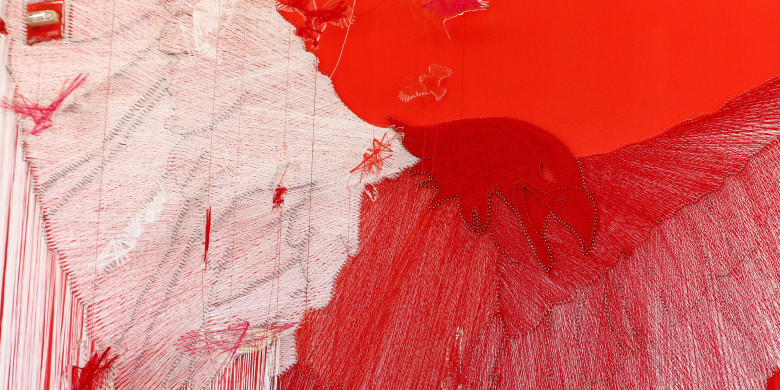
NORTH ADAMS, MASSACHUSETTS — Using thousands upon thousands of buttons and pins, Korean artist Ran Hwang returns to MASS MoCA to install Untethered, a 140-foot-long sculpture featuring 14 birds, including six phoenixes. Hwang’s recurring representation of birds in flight both echo the transient nature of existence and serves to represent ideal life achievements: limitless opportunities and freedom from worry. The piece, limited by architecture even in the generous gallery space of MASS MoCA, also suggests the contrary — that birds encounter predators and other obstacles, facing restrictions that are out of their control. Layered amidst the birds, metallic thread-spider webs emphasize that the more freedom is desired, the more difficult it is to achieve. Untethered opens with a reception for the artist on June 20, 2015.

Hwang finds beauty in the most ordinary circumstances. Choosing the humble button as a metaphor for mundane aspects of human existence, she creates extraordinary landscapes by hammering them into Plexiglas and wood panels in a repetitive and meditative process. Hwang notes, “I create monumental iconic imagery using materials from the fashion industry. I hammer thousands of pins into panels like a monk who, facing the wall, loses himself in deep concentration. The pins hold thousands of individual buttons. I choose buttons because, like human beings, they are at once common and ordinary yet as unique as the rarest jewels. Each button can move freely between the head of the pin and the wall, suggesting the human desire to be free from any restriction. For the viewer, the details of my work coalesce into a clever illusion — recalling the Zen masters’ lesson that life itself is an illusion, from which we can awake only by clearing our minds of daily distractions.”

About the Artist
Ran Hwang (born in 1960 in the Republic of Korea) lives and works in both Seoul and New York City. She studied fine arts at the School of Visual Arts in New York City and attended the Graduate School of Fine Arts at Chung-Ang University in Seoul. In addition to MASS MoCA, Hwang has exhibited at international arts institutions including: the Queens Museum of Art, New York; The Hudson Valley Center for the Arts, Hudson, New York; the Chelsea Art Museum, New York; The Seoul Arts Center Museum; the Jeju Museum of Art, Jeju Island; Third Floor-Hermès, Singapore; and the International Museum of Art and Science, McAllen, Texas. Hwang’s work is in numerous private and public collections including: The Brooklyn Museum, New York; The Des Moines Art Center, Iowa; The National Museum of Contemporary Art, Seoul; and the Hammond Museum, North Salem, New York. She has completed residencies at MASS MoCA and Vermont Studio Center, Johnson, Vermont, and received the 2004 Gold Prize from the AHL Foundation Annual Arts Competition, New York.

About MASS MoCA
MASS MoCA is one of the world’s liveliest (and largest) centers for making and enjoying today’s most important art, music, dance, theater, film, and video. Hundreds of works of visual and performing art have been created on its 19th-century factory campus during fabrication and rehearsal residencies, making MASS MoCA among the most productive sites in the country for the creation and presentation of new art. More platform than box, MASS MoCA strives to bring to its audiences art experiences that are fresh, engaging, and transformative.

MASS MoCA’s galleries are open 11am to 5pm every day except Tuesdays. The Hall Art Foundation’s Anselm Kiefer exhibition is open seasonally, reopening in spring 2015. Gallery admission is $18 for adults, $16 for veterans and seniors, $12 for students, $8 for children 6 to 16, and free for children 5 and under. Members are admitted free year-round. For additional information, call 413.662.2111 x1 or visit massmoca.org.

Download the Ran Hwang: Untethered press release


Liz Deschenes

For Immediate Release
16 January 2015
Contact: Jodi Joseph
Director of Communications
413.664.4481 x8113
jjoseph@massmoca.org

Liz Deschenes: Gallery 4.1.1

Prolific artist turns photography into a site-specific, sculptural, immersive, and interactive experience at MASS MoCA

“There was a striking economy of means in this photographic cave. Deschenes found a seemingly simple way to make viewers active participants in the work. The panoptic photograms ‘saw’ visitors to the extent that anyone in the space subtly altered the light cast onto each sheet. At the same time, viewers could see their own imperfect reflections in the surfaces. Standing in the gallery felt like being in nature–one was immersed in a sensate experience. Deschenes’s work is informed by a rigorous attention to the history of photography. But what speaks to me is the way she captures light. Deschenes often uses moonlight as the source of illumination, creating an ineffable feeling. I find that in much of her work, the order and permanence of architecture and the chaos of nature come together in an otherworldliness that brings the outside in.” — N. Dash on Liz Deschenes, July 2014

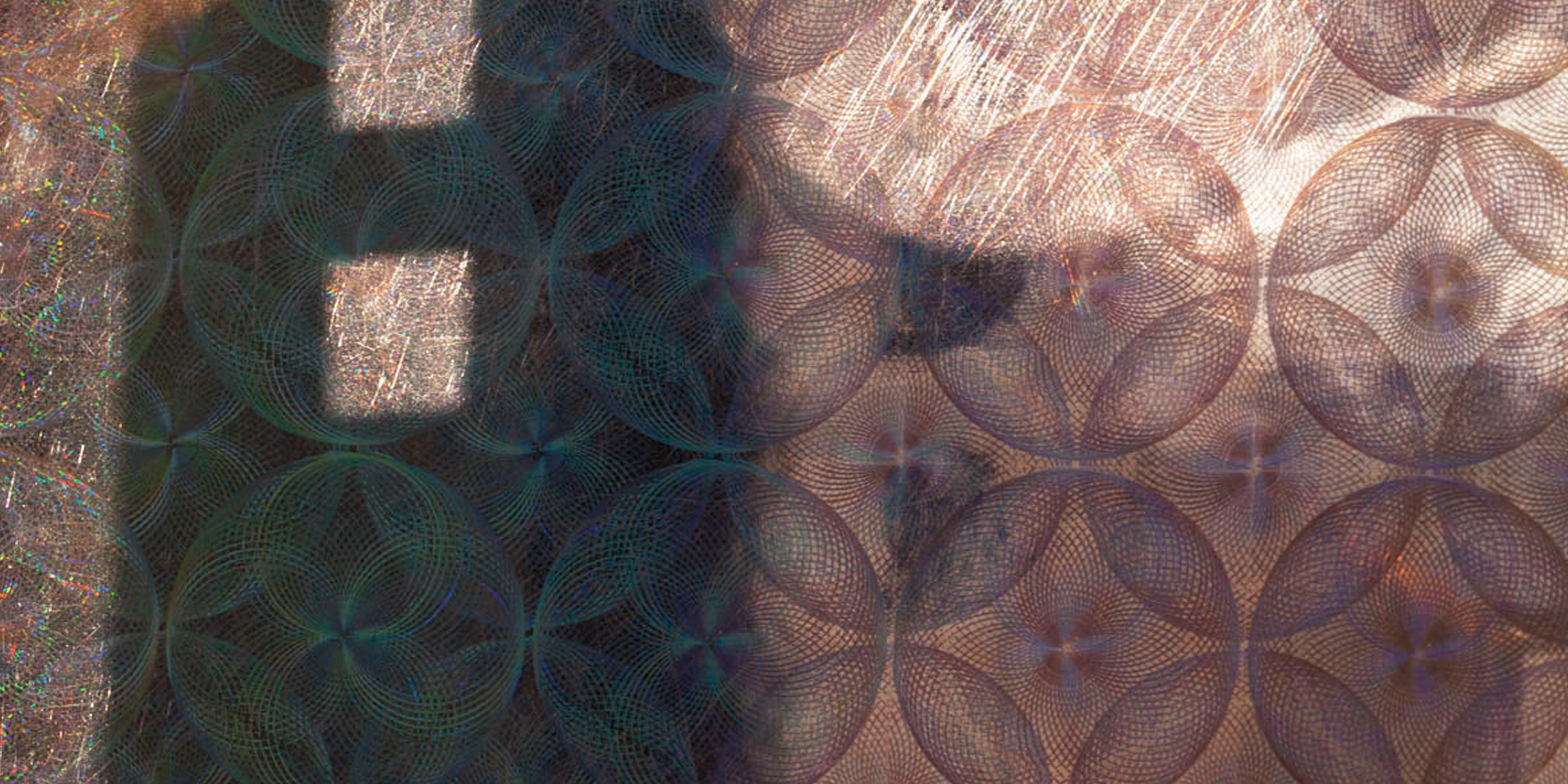
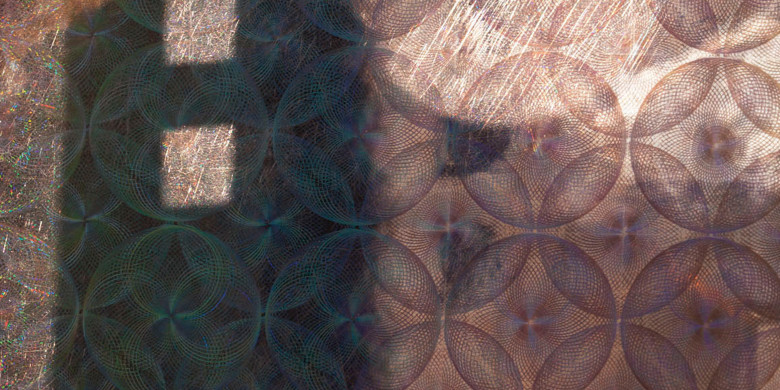
NORTH ADAMS, MASSACHUSETTS — One of the leading and most respected and influential photographers of her generation, Liz Deschenes takes the fundamental conditions of photography and its display as the subject of her work. Over the past two decades, she has expanded the possibilities of “self-reflexive” or “concrete” photography, making visible the materials and processes of the medium — namely, the interaction of paper, light, and chemicals. She is perhaps known best for her photograms that are produced without a camera. Deschenes returns to her native Massachusetts, showing new work in her first solo exhibition in the state, opening on May 23, 2015, with a reception for the artist.

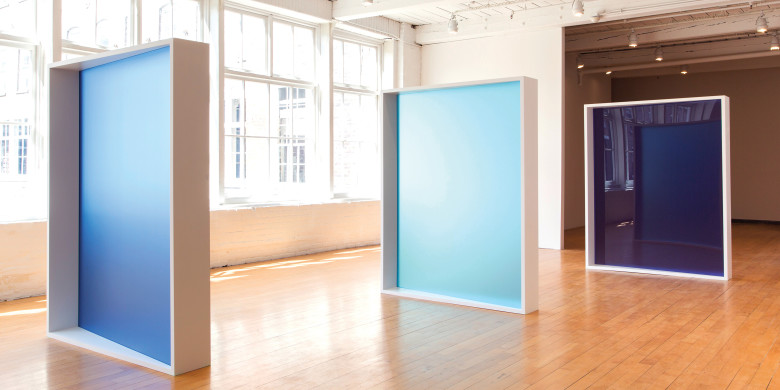
To create her atmospheric, monochromatic photograms, the artist exposes light-sensitive, silver-gelatin paper to ambient light before toning and fixing it. The variations in natural and artificial light, atmospheric conditions, and chemicals create marbleized, reflective surfaces that take on the look of metal and that continue to oxidize, darken, and change color over time. The complexity of Deschenes’ images is evident in the range of descriptions given them, which range from meditative, elegiac, and somber to playful, captivating, surprising, and mind altering.

The  artist’s works often engage directly with their surroundings, the unique architecture, lighting, and history of a space being active participants in the work. “Camera literally means ‘room’ in Latin,” Deschenes explains. In her work, the gallery can become a stand-in for the otherwise absent camera — as well as the traditional darkroom. At MASS MoCA, the natural light flooding through a wall of windows contributes to the constantly shifting appearance of Deschenes’ photographs, which continue to develop over time.

While Deschenes’ works are not representational in a traditional sense, her photographs record the passage of time as well as the changing conditions of the exhibition space, both in the reflections of viewers and their movement in the photographs’ mirror-like surfaces. In many instances, the works’ shaped supports are designed to mimic the shadows and light of a particular site. Deschenes’ photographs often take on sculptural qualities in their three–dimensional configurations and materiality, and also in the way they occupy the exhibition space. The pieces have variously been draped on the floor, hinged at right angles to the wall, situated in corners, or suspended from the ceiling. Both their careful placement and their non-referential images emphasize the viewer’s awareness of his or her own perceptual and physical experience in the gallery.

Deschenes practice is perhaps best described in her own words: “I am interested in photography cultivating a self-reflexive dialogue, while simultaneously reflecting the world at large, and utilizing a vocabulary that integrates concept with form.”

About the Artist
Born in Boston in 1966, Deschenes earned her B.F.A. at the Rhode Island School of Design in 1988. Since the 1990s, she has been exhibited widely across Europe and North America. Deschenes currently has a project on view at the Walker Art Center in Minneapolis and was recently the subject of a solo exhibition at the Secession, Vienna (2012). The artist’s work has also been featured in numerous group exhibitions, most notably at the International Center for Photography, New York (2014); Museum of Modern Art, New York (2013); and the Art Institute of Chicago (2012); and in the 2012 Whitney Biennial. Deschenes is represented in the collections of the Museum of Modern Art, New York; Metropolitan Museum of Art, New York; Whitney Museum of American Art, New York; CCS Bard Hessel Museum, Annandale-on-Hudson, New York; Walker Art Center, Minneapolis; Art Institute of Chicago; Hirshhorn Museum and Sculpture Garden, Washington D.C.; San Francisco Museum of Modern Art; and Centre Pompidou, Paris. Recently awarded the deCordova’s 2014 Rappaport Prize, Deschenes is also a professor in the visual arts department at Bennington College. She lives and works in New York.

Related Programming
In conjunction with her solo exhibition, Deschenes chose six artists for participation in a concurrent group exhibition, Artists’ Choice: An Expanded Field of Photography. The work of Dana Hoey, Craig Kalpakjian, Miranda Lichtenstein, Josh Tonsfeldt, Sara VanDerBeek, and Randy West is featured.

Sponsorship
This exhibition is supported by a grant from the Artist’s Resource Trust with additional funding provided by the Horace W. Goldsmith Foundation and the Massachusetts Cultural Council.

Images
A collection of high-resolution images is available here: http://bit.ly/1BMcMn2.

About MASS MoCA
MASS MoCA is one of the world’s liveliest (and largest) centers for making and enjoying today’s most important art, music, dance, theater, film, and video. Hundreds of works of visual and performing art have been created on its 19th-century factory campus during fabrication and rehearsal residencies, making MASS MoCA among the most productive sites in the country for the creation and presentation of new art. More platform than box, MASS MoCA strives to bring to its audiences art experiences that are fresh, engaging, and transformative.

MASS MoCA’s galleries are open 11am to 5pm every day except Tuesdays. The Hall Art Foundation’s Anselm Kiefer exhibition is open seasonally beginning spring 2015. Gallery admission is $18 for adults, $16 for veterans and seniors, $12 for students, $8 for children 6 to 16, and free for children 5 and under. Members are admitted free year-round. For additional information, call 413.662.2111 x1 or visit massmoca.org.


Download the Liz Deschenes: Gallery 4.1.1 press release


Bibliothecaphilia

For Immediate Release
4 November 2014
Contact: Jodi Joseph
Director of Communications
413.664.4481 x8113
jjoseph@massmoca.org

Bibliothecaphilia

Six artists wander through the stacks

NORTH ADAMS, MASSACHUSETTS — For centuries, libraries have exerted a quiet sort of gravity, pulling us in with the promise that for a while, in the hushed, book-filled corridors, we can exceed ourselves. But, in this age of eBooks and library apps, does the physical and philosophical space of the library remain relevant? And what qualities define a library? Can libraries exist digitally, or be constituted of things other than books? The six artists in Bibliothecaphilia, on view beginning January 24,  2015, explore the medium and ethos of libraries: institutions straddling the public and private spheres, the escapism that libraries offer, libraries’ status as storehouses for physical books — and thus for experiences and knowledge — and the way that these objects circulate and are re-used. Participating artists include Clayton Cubitt, Jonathan Gitelson, Susan Hefuna, Meg Hitchcock, Dan Peterman, and Jena Priebe.

Bibliotheca: From the Greek βιβλιοθήκη, meaning library. “Traditionally, collection of books used for reading or study, or the building or room in which such a collection is kept.”

-philia: From the Greek φιλία, meaning friendship. …A suffix meaning “friendly feeling toward, […] tendency toward, […or] abnormal appetite or liking for.”

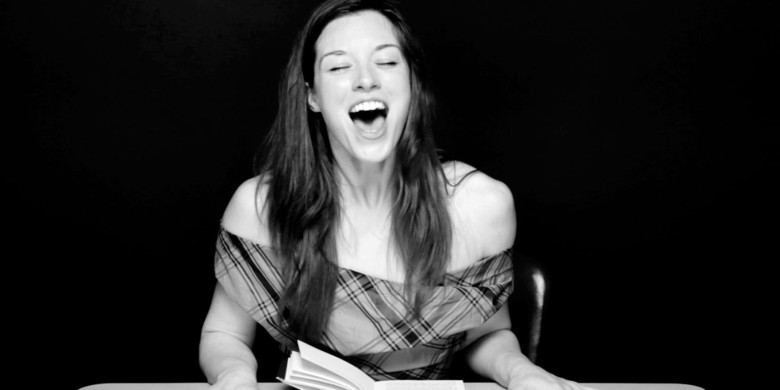
Perhaps no work in Bibliothecaphilia likes the library more than Clayton Cubitt’s Hysterical Literature.  In each “session” of Hysterical Literature, the camera captures a woman from across a table as she reads aloud from a book that she has selected for her “session.” Slowly we become aware of an unseen force — is it the book or the unseen assistant, pleasuring her with a vibrator below the table, which sends her into titular hysterics? One woman writes of her session, “This is my revolutionary act of selfishness… my virtual picket sign… my one-woman rally… my rebel yell… my sedentary march… a call for dialogue and understanding.”

In Jonathan Gitelson’s work, Marginalia, the presence of books’ previous readers is felt despite their physical absence. The markings and ephemera that they leave behind invite us to imagine their relationship to the text — a relationship that, he writes, “may be a dying mystery […] with the advent of e-books and computer-based reading.” In Marginalia, visitors have the opportunity to explore shelves of marked books that Gitelson has collected in a work that includes bits of ephemera found in the books and silkscreens that show bright lines of highlighting drawn from the pages of the books — from which the printed words have been removed.

Dan Peterman’s work likewise deals with the repurposing of used materials. In place of books, however, Peterman’s work utilizes pieces of compressed post-consumer plastic. His previous installations include Archive (one-ton), 2012, which occupied a former private library, where he filled the shelves with paperback-sized boards of plastic to act as “surrogate books,” and a 100-foot long continuous table in a public park, at which, each day, strangers dine together (Running Table, 1990).  Like the books of a library, these materials form part of a circulating network of individuals whose knowledge of one another is limited to their shared connections to the materials that they (re)use.

Jena Priebe and Meg Hitchcock’s works engage with the reuse of texts that takes place in libraries, as well as the interaction between books and readers. For Priebe, who often uses books that have been deaccessioned from libraries as materials in her work, books become fodder for immersive installations populated by towers of tomes and swirling streams of pages that appear to defy the laws of physics. Her works blur the boundary between the physical material of the book and the reader’s mental experience of the text. Hitchcock’s intimate Texts brings the books themselves into conversation, using letters and words from one holy text to recreate the verses of another. In her hands, the books are transformed into geometric meditations on interconnectedness.

Susan Hefuna’s mashrabiyas isolate the interstitial space between public and private life that libraries so often occupy. Historically, mashrabiyas, large-scale carved wooden screens, were placed in windows to allow air to circulate. Hefuna became interested in the way that they allowed women to view the outside world while being shielded from the public eye: “You see life outside the room, hear the cars and feel the hectic pace of the city — but you yourself are in calm surroundings, so it’s therefore very meditative.” Dyed with ink, the patterns of Hefuna’s large-scale screens are woven with spare words and phrases, with past and present resonances with which viewers are called to engage.

Ranging in scale from intimate to all-encompassing, these artists’ works prompt both private contemplation and public exchange, and invite us to imagine what might be lost if libraries — those archives of paradise and longings — should truly disappear.

Related Programming
The exhibition coincides with a year-long initiative at Williams College (including the Williams College Museum of Art and Clark Art Institute) dedicated to books, libraries, and information. It focuses on exploring the diverse ways in which people preserve and convey ideas, creative works, data, and other forms of information. The project features a wide array of public presentations, performances, courses, and exhibitions (including at the Williams College Museum of Art and Clark Art Institute) that imagine the theme from many perspectives.

Sponsorship
This exhibition is made possible by the Sterling and Francine Clark Art Institute in support of MASS MoCA and the Williams College Graduate Program in the History of Art.

About the Artists
Clayton Cubitt’s (b. 1972, New Orleans, LA) practice includes video art, fashion photography, and photojournalism. He embraces internet videos and blogs as media for widely accessible artistic engagement, receiving millions of visits from viewers worldwide. He lives in New York, NY.

Jon Gitelson (b.1975, Mount Kisco, NY) draws inspiration from chance events, ritual, and the archive. His work is included in the collections of the Victoria and Albert Museum, MoMA, and Whitney Museum of American Art. He lives in Brattleboro, VT.

Susan Hefuna (b. 1962, Germany) works in media including video, sculpture, and performance, exploring networks that structure public interaction. Her work was included in recent exhibitions at MoMA, Serpentine Gallery, and the Venice Biennial. She lives in Egypt and Germany.

Although Meg Hitchcock (b. 1961, Springfield, VT) trained as a painter, it was her longstanding interest in religion and philosophy that inspired her Texts. Her work has been featured in New Criterion and Art Critical, and was recently exhibited at Crystal Bridges. She lives in Brooklyn, NY.

Dan Peterman (b.1960, Minneapolis, MN) creates works that blur accustomed boundaries between art and functional objects, often using recycled materials. His work has been exhibited at the Venice Biennal, Kunsthalle Basel, and Chicago’s Millennium and Grant Parks. He lives in Chicago, IL.

Jena Priebe (b. 1978, Michigan) uses vintage and found objects to create immersive environments that juxtapose organic and mechanical, real and surreal. She has created site-specific works for The Last Bookstore, Los Angeles, and the Burning Man festival. She lives in Los Angeles, CA.

Images
A collection of high-resolution images is available here: http://bit.ly/1x4MSui.

About MASS MoCA
MASS MoCA is one of the world’s liveliest (and largest) centers for making and enjoying today’s most important art, music, dance, theater, film, and video. Hundreds of works of visual and performing art have been created on its 19th-century factory campus during fabrication and rehearsal residencies, making MASS MoCA among the most productive sites in the country for the creation and presentation of new art. More platform than box, MASS MoCA strives to bring to its audiences art experiences that are fresh, engaging, and transformative.

MASS MoCA’s galleries are open 11am to 5pm every day except Tuesdays. The Hall Art Foundation’s Anselm Kiefer exhibition is open seasonally, through November 30.  Gallery admission is $18 for adults, $16 for veterans and seniors, $12 for students, $8 for children 6 to 16, and free for children 5 and under. Members are admitted free year-round. For additional information, call 413.662.2111 x1 or visit massmoca.org.
Download the Bibliothecaphilia press release


  • « Previous Page
  • 1
  • …
  • 5
  • 6
  • 7

TAKE PART

Newsletter sign-up
Mass MoCA Instagram Mass MoCA Facebook Mass MoCA YouTube
LOGIN ABOUT HOST EVENTS / OFFICE SPACE PRIVACY POLICY Consent Policy

MASS MoCA

1040 MASS MoCA WAY
North Adams, MA 01247

413.662.2111

info@massmoca.org

Copyright © 2025 Massachusetts Museum of Contemporary Art

Barr Foundation Massachusetts Office of Travel & Tourism
Consent Preferences