Search
  • Visit
    • Get Tickets
    • Visit
    • Digital Guide
    • Frequently Asked Questions
    • Directions
    • Groups
    • Stay
    • Eat
    • Accessibility
    • Courtesy Code
    • On Campus
  • Events
  • Exhibitions
    • Current
    • Upcoming
    • Long-Term
    • Sound Art
    • Sol LeWitt
    • Anselm Kiefer
    • Past Exhibitions
  • Performing Arts
    • Upcoming Performances
    • MASS MoCA Records
    • Past Performances
  • Public Programs
    • Public Programs
    • Kidspace
    • Education
    • Teens
    • Camp Mass MoCA
  • Residencies
    • The Studios at MASS MoCA
    • Resident Artists
  • About
    • About
    • 2024–2030 Strategic Plan
    • Leadership
    • Commitment to Community Values, People & Place
    • History
    • Press Room
    • Jobs & Opportunities
    • Host Event / Rent Space
    • Land
    • Contact
  • Shop
    • Online Gift Shop
    • Research & Development Store
  • Join/Give
    • Give Now
    • Become a Member
    • Host Event / Rent Space
Search
START TYPING AND PRESS ENTER TO SEARCH
  • Visit
    • Get Tickets
    • Visit
    • Digital Guide
    • Frequently Asked Questions
    • Directions
    • Groups
    • Stay
    • Eat
    • Accessibility
    • Courtesy Code
    • On Campus
  • Events
  • Exhibitions
    • Current
    • Upcoming
    • Long-Term
    • Sound Art
    • Sol LeWitt
    • Anselm Kiefer
    • Past Exhibitions
  • Performing Arts
    • Upcoming Performances
    • MASS MoCA Records
    • Past Performances
  • Public Programs
    • Public Programs
    • Kidspace
    • Education
    • Teens
    • Camp Mass MoCA
  • Residencies
    • The Studios at MASS MoCA
    • Resident Artists
  • About
    • About
    • 2024–2030 Strategic Plan
    • Leadership
    • Commitment to Community Values, People & Place
    • History
    • Press Room
    • Jobs & Opportunities
    • Host Event / Rent Space
    • Land
    • Contact
  • Shop
    • Online Gift Shop
    • Research & Development Store
  • Join/Give
    • Give Now
    • Become a Member
    • Host Event / Rent Space

The Lure of the Dark Contemporary Painters Conjure the Night

Jeronimo Elespe Lure

For Immediate Release
2 March 2018
Contact: Jodi Joseph
Director of Communications
413.664.4481 x8113
jjoseph@massmoca.org


The Lure of the Dark: Contemporary Painters Conjure the Night

Featuring paintings — including new commissions — by a diverse group of over a dozen contemporary artists

NORTH ADAMS, MASSACHUSETTS — From Rembrandt and The Night Watch to Georges de La Tour’s candlelit scenes of the seventeenth century, James McNeill Whistler’s woozy Nocturnes, Vincent van Gogh’s dizzying Starry Night, and Edward Hopper’s lonely Nighthawks, artists have sought to capture the mood of the night. Featuring paintings — including new commissions — by a diverse group of over a dozen contemporary artists, including Patrick Bermingham, William Binnie, Cynthia Daignault, Noah Davis, TM Davy, Jeronimo Elespe, Cy Gavin, Josephine Halvorson, Shara Hughes, Sam McKinniss, Wilhelm Neusser, Dana Powell, Kenny Rivero, and Alexandria Smith, The Lure of the Dark opens on Saturday, March 3, with a members opening reception on Saturday, March 24, at 5:30pm.

Sex, death, romance, magic, terror, wonder, alienation, and freedom — the night invites a myriad of often contradictory associations. For centuries, painters have been drawn to the mysteries and marvels of the night and its perceptual and poetic possibilities.

Of course, an exhibition about the night is also about the light that illuminates the darkness, from the moon and the stars, to candles, cigarettes, and the glow of cell phones. Many of the artists in The Lure of the Dark look back to predecessors, capturing the night en plein air, sometimes completing a painting in a single sitting or night. The exhibition illustrates the ways in which the hours of darkness continue to provoke the contemporary imagination, providing apt metaphors for the diversity and intersections of human experience along with the anxious tenor of the day.

Patrick Bermingham has been painting the night for over two decades, both inside his studio and outside under the moonlight. The muted palette of his massive 8×16 ft. work, Midway on our path of life (2017) approximates the limited gray, black, and white hues that we see at night. The shift that occurs as night vision and the rods take over also happens with Bermingham’s paintings, which are exhibited in very low light. With patient looking, the rather sketch-like appearance of the large high-contrast painting becomes more clearly defined, and the work appears to glow with moonlight.

Texas-raised, Williamstown resident William Binnie pictures the racial terror associated with night with his recent work The Vine that Ate the South (2018). In his hyperrealist style, he examines the myth surrounding kudzu, a non-native species that lives large in the Southern imagination as a monstrous weed that enshrouds millions of acres in land under its dark tangled mass. A burning torch on the same canvas evokes the frightening images of the white nationalist rally in Charlottesville.

Outside a small, remote cabin in nearby Stockport, New York, Cynthia Daignault spent a winter alone, painting 40 Days / 40 Nights (2014). Working en plein air, she painted two paintings each day over the course of 40 days, spending four to six hours painting a view through the trees in daylight and then another four to six hours painting the view after the sun set. Painting the same patch of forest and sky night after night, Daignault beautifully captures the dramatic changes in light and color — from the pinks and oranges of sunset to the deep blues and blacks of the witching hours.

Painted after his father’s death, Noah Davis’ Painting for My Dad (2011) taps into night’s close association with death — the sleep that does not end. Depicting a lone figure carrying a lantern into the dark in what looks like a deep cave or an infinite starry night sky, the painting has become even more poignant in the wake of the artist’s own death in 2015.

In an homage to Henri Rousseau’s The Sleeping Gypsy (1897), TM Davy has created the monumental Fire Island Moonrise. Painted in his masterful, traditional style, the 11×11 ft. self-portrait with his husband transports viewers to the transcendent, erotically charged beach scene. Looking up at the work, you can almost feel the light on your face and the domed sky above your head.

Showing two new works, including one that measures nearly 15 feet, Cy Gavin often paints the night. Drawn to the darkness when color is difficult to discern, he lets his imagination take over. His fantastic hues — acid greens and fluorescent pinks — are inspired in part by the vivid colors of Bermuda by day: pink hibiscus, green ferns, turquoise water, and the purple iris-like Bermudiana flower. They also impart the intense emotions embedded in the land and the legacies of slavery that linger on the island. For MASS MoCA Gavin painted a monumental image of Bash Bish Falls under ice, paying homage to the landscapes of Caspar David Friedrich.

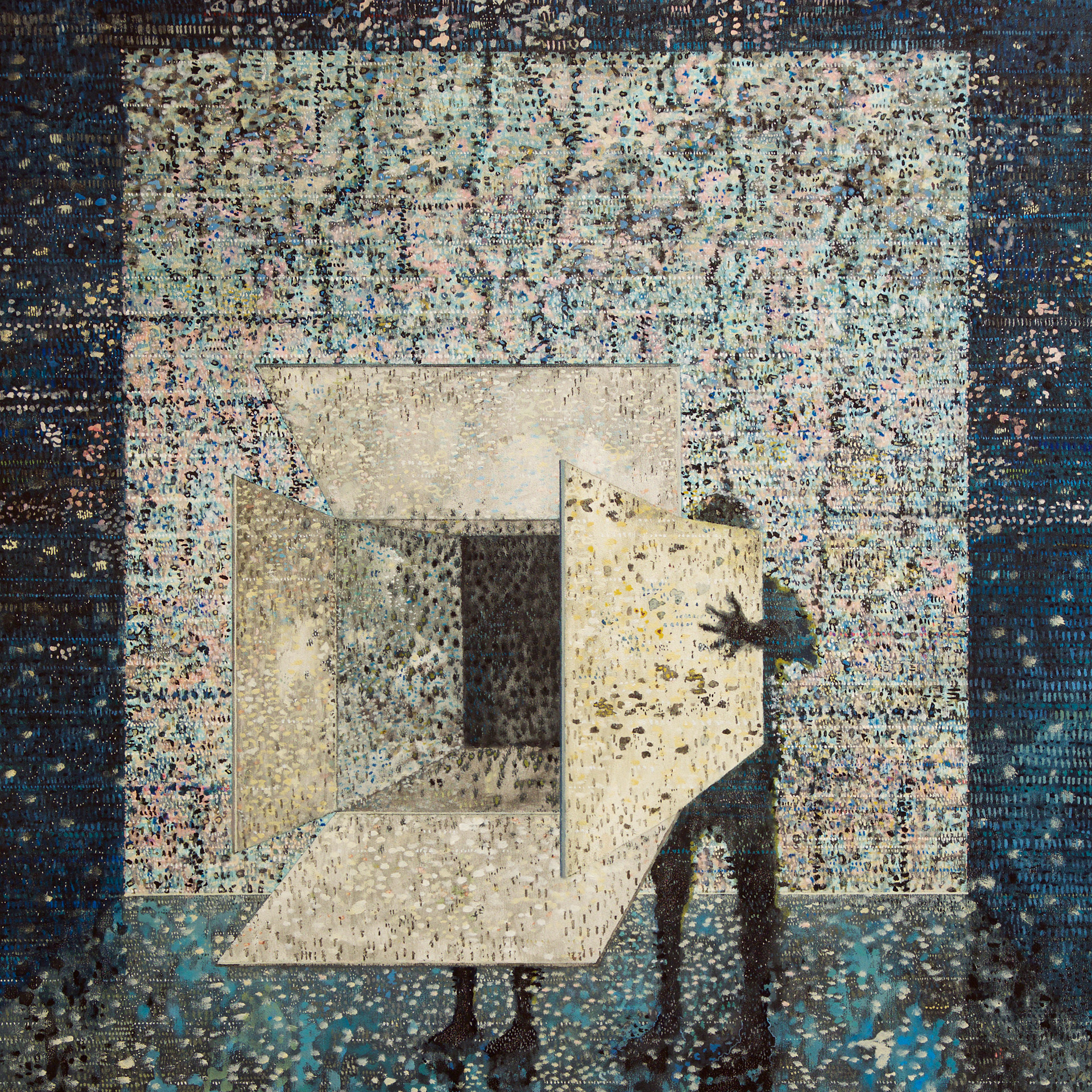
Jeronimo Elespe paints dreamlike scenes based on autobiographical details, lingering between myth and the mundane. The artist’s pointillist-like application of paint often evokes the illusion of night, creating atmospheric images that suggest the dark. In Hesperides (2017) the maidens of the evening from Greek mythology emerge like ghosts from a crepuscular mist wearing head scarves and carrying goblets.

Josephine Halvorson, who is based in nearby New Marlborough, MA, created her “Night Window” works during a residency at the French Academy at the Villa Medici in Rome between 2014 and 2015. Each painting in the series is a unique iteration of a single view of the window in her atelier and the night sky beyond. They are titled with the date on which they were painted, a cue that each is a distinct portrait of a particular experience. Together the works are a study of nuance and the passage of time on both human and cosmological levels.

Shara Hughes’ vibrant, invented landscapes pay homage to a pantheon of early 20th-century painters, including Henri Matisse and the Fauves, Vincent van Gogh, Ernst Ludwig Kirchner, Marsden Hartley, and Arthur Dove. Hughes often allows confusion between the illusion of moonlight and sunlight in her paintings, as is true in Spins from Swiss (2017). The work was inspired by the artist’s experience of driving through the mountains of Switzerland. Moving in and out, up and down, between dark and light, the painting recreates the dizzying feeling of the circuitous roads and soaring peaks.

Known for paintings based on images he sources online, from animals and flowers to celebrity portraits (he was commissioned to paint the musician Lorde for the cover of her 2017 album Melodrama), Sam McKinniss is showing a new work based on an image of singer Lana Del Rey. Another new work, Northern Lights (2017), an ecstatic vision of the Aurora Borealis that suggests the technicolor light displays and drug-induced hallucinations of urban nightclubs.

Dana Powell began her series of night paintings in the aftershocks of the 2016 presidential election. Conveying the anxious tenor of the time, images of desolate roadways — like Ghost Drive (2017) — are filled with the suspense of an Alfred Hitchcock film. The dark scene, and the hazy apparition visible on the side of the road, invite any number of imagined scenarios as we wonder what might be waiting around the next bend.

A recent artist-in-residence in MASS MoCA’s studio program, Wilhelm Neusser looks to the legacy of Caspar David Friedrich and German Romanticism in his enigmatic landscapes which seem to be as much a psychological terrain as a specific geography. In Nocturne/Doublemoon (2017), he merges the mysterious atmosphere of Romantic painting with elements of Haruki Murakami’s novel 1Q84, named for George Orwell’s dystopian vision of 1984. The intense, green glow of Neusser’s painting gives it a futuristic feel while reminding us that at night, it is the light with the shortest wavelengths — green — that can be seen best.

Kenny Rivero’s new work was begun at the nearby Buxton School where the artist, formerly a student, was in residence in August 2017. The work recalls the dramas of his Washington Heights neighborhood and both the excitement and fears inspired by a nocturnal New York lit by street lamps, car lights, fires, and the warm glow emanating from apartment windows.

Alexandria Smith’s paintings frame the body as something slightly wild and unruly — a foreign terrain to be explored like the night. Her cartoon-like images suggest a child’s point of view, while evoking images from fairy tales, which often articulate social taboos that twist the formation of identity and ideas about race, gender, and sexuality. In The Skin We Speak (2017), the night offers a refuge for two young women — or the self and a reflection — to explore a language spoken by the body, undeterred by the narratives of others.

About the Artists
Patrick Bermingham (b. Hamilton, Ontario) lives between Toronto and Dundas, Ontario. He received a BFA from Central St. Martins, London. He also apprenticed with printmaker David Blackwood and sculptor Elizabeth Holbrook and worked in the studio of Anthony Caro. Since 1995, he has been making night paintings in locations including Guatemala, Morocco, and Canada’s Georgian Bay. Recent exhibitions include installations at Hughes Room, Toronto (2015), and in the No Vacancy Art Festival in conjunction with the Art Gallery of Burlington (2016). His work is on view at the Canadian Embassy in Washington, D.C.  In 2014 he won a commission to design a large-scale monument to workers by the United Operating Engineers Union in Oakville, Ontario.

William Binnie (b. 1985, Dallas, TX) lives and works between New York and Williamstown, MA. He holds a BA from Pitzer College, Claremont, CA, and an MFA from SMU Meadows School of the Arts. He has had solo exhibitions at LMAKgallery, New York (2017); Paul Loya Gallery, Los Angeles (2016); The Public Trust, Dallas (2013); and Greg Kucera Gallery, Seattle (2013). Binnie’s work has been included in group shows at UNO-St. Claude Gallery, University of New Orleans (2017); HVW8, Los Angeles (2016); the University of Texas at Dallas (2016); Dallas Contemporary, Dallas (2014); and Ballroom Marfa, Marfa, TX (2013). In 2014, Binnie participated in the Robert Rauschenberg Foundation Artist Residency program in Captiva, Florida.

Cynthia Daignault (b. 1978, Baltimore, MD) lives and works in Brooklyn, NY. She earned her BA from Stanford University. She has had solo exhibitions at The Sunday Painter, London (2017) The FLAG Art Foundation (2017); Rowhouse Project, Baltimore (2015); and White Columns, New York (2011). Her work has been included in numerous group shows at venues including the Institute of Contemporary Art at Maine College of Art, Portland, ME (2017); Metropolitan Museum of Art, NY (2017); the Brooklyn Museum, NY (2014, 2015); the Museum of Contemporary Art Denver (2015); and the Modern Art Museum of Fort Worth (2014). Awards include a Rema Hort Mann Foundation grant (2011) and a MacDowell Colony fellowship (2010).

Noah Davis (b. 1983, Seattle, WA; d. 2015, Ojai, CA) was a painter and installation artist who primarily worked out of Los Angeles. He studied at Cooper Union School of Art in New York.  In 2012, he and his wife Karon Davis co-founded the Underground Museum in the working-class neighborhood of Arlington Heights in Los Angeles. He had solo shows at the Museum of Contemporary Art, Los Angeles, CA (2015); Papillion Gallery, Los Angeles, CA (2014); Roberts and Tilton, Culver City, CA (2013), James Harris Gallery, Seattle, WA (2012), and Tilton Gallery, New York, NY (2011).  In 2017 the Frye Art Museum, Seattle, featured his paintings in a two-person show with the work of his brother, Kahlil Joseph. His work has also been included in exhibitions at the Studio Museum of Harlem, New York, NY (2012); Torrance Art Museum, Torrance, CA (2012); the Corcoran Gallery, Washington, D.C. (2011); and the Santa Barbara Museum of Art, Santa Barbara, CA (2010).

TM Davy (b. 1980, New York, NY) lives and works in Brooklyn, New York, and holds a degree from the School of Visual Arts He has had solo exhibitions at 11R, New York (2017) and Exile, Berlin (2011); his work has also been featured in LISTE Art Fair, Basel, Switzerland (2012). Davy’s work has been included in group exhibitions at the FLAG Art Foundation, New York (2017); The LeRoy Neiman Gallery, Columbia University, New York (2016), the 10th Gwangju Biennale (2014); the Witte de With Center for Contemporary Art, Rotterdam, the Netherlands (2013); Tate Modern, London, (2010); and Centro Galego de Arte Contemporánea, Santiago de Compostela (2010). His paintings have been featured in Sarah Michelson’s performance projects at the Whitney Biennial, New York (2012); the Museum of Modern Art, New York (2012); and The Kitchen, New York (2011).

Jeronimo Elespe (b. 1975, Madrid, Spain) lives and works in Madrid. He holds a BFA from the School of Visual Arts and an MFA from Yale University. He has had numerous solo exhibitions at 11R, New York (2011, 2013, 2015); LABOR, Mexico City (2015); Ivorypress, Madrid (2014); Centro de Arte Contemporáneo, Málaga, Spain (2012); and the University Museum of Contemporary Art, UMass, Amherst, MA (2004). Elespe’s work has been included in group shows at institutions such as Museo de Arte Contemporáneo, Coruña, Spain (2013); Museo de Arte Moderno y Contemporáneo de Santander, Spain (2013); and the Tang Museum, Skidmore College, Saratoga Springs, NY (2006).

Cy Gavin (b. 1985, Pittsburgh, PA) lives outside Poughkeepsie, New York. He received a BFA from Carnegie Mellon University and an MFA from Columbia University. He has had recent solo exhibitions at Various Small Fires, Los Angeles (2017); and Sargent’s Daughters, New York (2015, 2016), as well as group shows at JTT Gallery, New York (2017); Callicoon Fine Arts, New York (2017); Carl Kostyál Gallery, Stockholm (2017); and the Rubell Family Collection, Miami, where he was an artist-in-residence in 2016.

Josephine Halvorson (b. 1981, Brewster, MA) lives and works in western Massachusetts. She earned a BFA from Cooper Union and an MFA from Columbia University. She has had solo exhibitions at Storm King Art Center, New Windsor, NY (2016); Sikkema Jenkins & Co., New York (2015); the Southeastern Center for Contemporary Art, Winston-Salem, North Carolina (2015); and Fondation des États-Unis, Paris, France (2008). Her work has been included in group exhibitions at the Wexner Center for the Arts, Columbus, OH (2017); Sheldon Museum of Art, University of Nebraska, Lincoln (2016); Fondazione Memmo Arte Contemporanea, Rome (2015); High Museum of Art, Atlanta (2014); and the School of Visual Arts, New York (2010). Awards and residencies include a Louis Comfort Tiffany Foundation Grant (2009); a Rome Prize from French Academy at the Villa Médicis, Italy (2014-15); and the Rauschenberg Residency in Captiva, FL (2016).

Shara Hughes (b. 1981, Atlanta, GA) lives and works in Brooklyn, NY. She earned her BFA from the Rhode Island School of Design. She has had solo exhibitions at Rachel Uffner, New York (2017); Gallery Met, Metropolitan Opera, New York (2017); Marlborough Chelsea (2016); MOCA GA, Atlanta (2014); the Atlanta Contemporary, Atlanta (2013); and Metroquadro, Rivoli, Italy (2011, 2009). Her work was included in the Whitney Biennial, New York (2017), and in numerous group exhibitions at venues such as Brand New Gallery, Milan (2016), and the High Museum of Art, Atlanta (2015). Hughes has also been an artist-in-residence at the Atlantic Center for the Arts (2013) and the Working Artist Project at MOCA GA (2012), and attended the Skowhegan School of Painting & Sculpture (2011).

Sam McKinniss (b. 1985, Northfield, MN) lives and works in New York City. He holds a BA from the University of Hartford and an MFA from New York University. Solo exhibitions of his work have been shown at team (gallery, inc), New York (2016); team (bungalow), Los Angeles (2015); Proof Gallery, Boston (2010); New Britain Museum of American Art, New Britain, CT (2008) and Real Art Ways, Hartford, CT (2008). His work has been included in group exhibitions at JTT, New York (2017); Berggruen Gallery, San Francisco, CA (2017); Robert Blumenthal Gallery, East Hampton, NY (2014); and Mills Gallery, Boston Center for the Arts, Boston, MA (2011). McKinniss received the New Boston Fund Individual Artist Fellowship from Greater Hartford Arts Council (2009) and was a GO!, Emerging Artist Contest Winner for Real Art Ways (2008).

Wilhelm Neusser (b. Cologne, Germany) studied at the Staatliche Akademie der Bildenden Künste in Karlsruhe. He lived and worked in Cologne until his relocation to the United States in 2011. His work has been widely exhibited, and he has received numerous awards and fellowships, including ZVAB Phönix Art Prize, Tutzing am Starnberger See; Artist Research Trust (A.R.T.) Fellowship at the Vermont Studio Center, Johnson, VT. He has had residencies at Boots Contemporary Art Space, St. Louis, MO; and Vermont Studio Center. He also participated in MASS MoCA’s residency program. Neusser lives and works in Cambridge, MA.

Dana Powell (b, 1989, Milwaukee, WI) graduated with a BFA from Cooper Union in 2015. She has had solo shows at James Fuentes’ Allen & Eldridge, New York, NY; Sardine Gallery, Brooklyn, NY; and The Still House Group, Brooklyn, NY. Her work has been included in group shows at many venues including, Castledrone, Boston, and County Gallery, Palm Beach, and in 2017 her work was chosen as an Artforum Critic’s Pick. She currently lives and works in Brooklyn, New York.

Kenneth Rivero (b. New York, NY) currently lives between New York City and New Haven, NY. He holds a BFA from the School of Visual Arts, NY, and an MFA from Yale University, New Haven, CT. He has had solo exhibitions at the Elizabeth Foundation for the Arts, New York (2017) and Roswell Museum and Art Center, Roswell, NM (2016). Rivero’s work has been included in group exhibitions at the Perez Art Museum, Miami, FL (2017); Zilkha Gallery at Wesleyan University, Middletown, CT (2017); the Contemporary Art Museum St. Louis, MO (2015); Centro Cultural de España en Santo Domingo, Santo Domingo, Dominican Republic (2015); Bronx Art Space (2014); N’Namdi Center for Contemporary Art, Detroit, MI (2014); El Museo del Barrio, New York (2013); and Pera Museum, Istanbul (2009). He was awarded residencies at Skowhegan School of Painting & Sculpture (2017); the Fountainhead Residency, Miami, FL (2016); the Roswell Artist-in-Residence Program, Roswell, NM (2015); and the Lower Manhattan Cultural Council Workspace program, NY (2014).

Alexandria Smith (b. 1981, Bronx, NY) lives and works in Brooklyn, NY. She earned a BFA in illustration from Syracuse University and an MFA from The New School’s Parsons School of Design. She also holds an MA in Art Education from New York University. She has had recent solo exhibitions at the Ark Gallery, University of Iowa (2016); Scaramouche Gallery, New York (2014); and Rush Arts Gallery, New York (2011); and has been included in group exhibitions at Barbara Gladstone Gallery, New York (2015); The Schomburg Center, New York (2014); and Thierry Goldberg Gallery, New York (2014). Smith is the recipient of numerous awards and residencies including, most recently, Skowhegan School of Painting & Sculpture (2015); the Virginia A. Myers Fellowship at the University of Iowa (2015), A.I.R. Gallery Fellowship, Brooklyn, NY (2014); and the Fine Arts Work Center, Provincetown, MA (2013, 2014). She is an Assistant Professor of Art at Wellesley College in Massachusetts.

Sponsorship
Major exhibition support is provided by the Horace W. Goldsmith Foundation, the Barr Foundation, and the Massachusetts Cultural Council. Contributing exhibition support is provided by The Artist’s Resource Trust (A.R.T.) Fund, a fund of Berkshire Taconic Community Foundation.

Images
High-resolution images are available through this link: bit.ly/LureoftheDark.

About MASS MoCA
MASS MoCA is one of the world’s liveliest (and largest) centers for making, displaying, and enjoying today’s most important art, music, dance, theater, film, and video. MASS MoCA’s more than 250,000 sq. ft. of gallery space includes partnerships with Laurie Anderson, the Louise Bourgeois Trust, Jenny Holzer, Anselm Kiefer with the Hall Art Foundation, Sol LeWitt, and James Turrell.

Gallery admission is $20 for adults, $18 for veterans and seniors, $12 for students, $8 for children 6 to 16, and free for children 5 and under. Members are admitted free year-round. The Hall Art Foundation’s Anselm Kiefer exhibition is seasonal and will reopen on May 26, 2018. For additional information:

413.662.2111 x1 or visit massmoca.org.

Hours
MASS MoCA is open from 11am to 5pm, closed Tuesdays, through June 22. From June 23 through September 3, MASS MoCA’s galleries are open seven days a week — from 10am to 6pm Sundays through Wednesdays and from 10am to 7pm Thursdays through Saturdays.
Download The Lure of the Dark press release here.

ASSEMBLED AUDIENCE + A COLD HOLE

For Immediate Release
8 February 2018
Contact: Jodi Joseph
Director of Communications
413.664.4481 x8113
jjoseph@massmoca.org


TARYN SIMON:

ASSEMBLED AUDIENCE + A COLD HOLE

World premiere of two new large-scale installations

NORTH ADAMS, MASSACHUSETTS — In an ambitious exhibition featuring two new installation-based commissions, artist Taryn Simon activates the rituals of applause and the cold water plunge, examining individuals’ campaigns for public admiration, the status of physical community spaces in the digital age, and our persistent desire for a quick fix. Simon’s exhibition opens at MASS MoCA on Saturday, May 26, with a reception that evening.

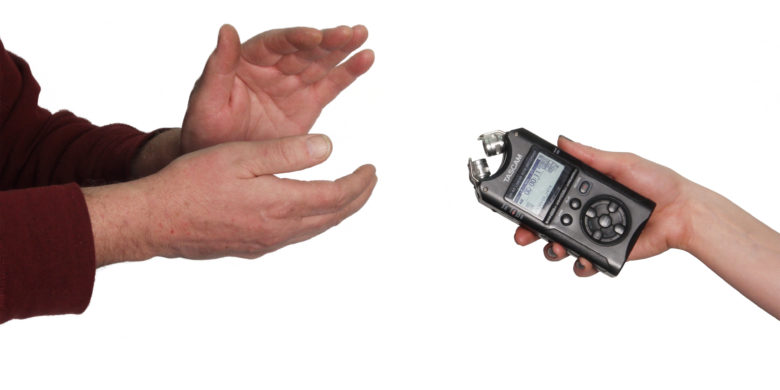
Children learn to seek applause from an early age — an ambition for approval that continues to shape public performances. Clapping transmits contagiously: individuals clap to signal consensus, out of love, to join the crowd.

Cold water plunges — on holy days, as viral stunts, or as solitary strategies for personal reset — have a long history of notable participants. Apache leader Geronimo employed cold-water immersion to prepare boys for manhood and battle. Russian President Vladimir Putin observed the tradition of reenacting Christ’s baptism by plunging into cold water on Epiphany, instead of watching President Donald Trump’s inauguration.

Rooted in the artist’s longtime interest in the systems that support power structures, and building on her recent work with sound, thresholds, and sculpture, Simon’s uncompromising, timely exhibition examines how public performance collides with private intentions and experiences. Filling the museum’s expansive first-floor galleries, Simon’s exhibition features large-scale immersive works — Assembled Audience and A Cold Hole — as well as the first-ever major museum installation of the artist’s bookwork.

In the dark interior of Assembled Audience, visitors are consumed by a densely layered soundscape of percussive strikes — thousands of individually recorded claps, which Simon has composed to generate a new virtual crowd. In A Cold Hole, the gallery floor is replaced by an expanse of solid ice with a single square hole cut from its center. Both visitors and performers are intermittently invited to jump into the icy water below. Visitors can view A Cold Hole through a cinemascopic aperture from a darkened adjacent gallery.

Clapping and cold-water immersion have historically functioned as modes for public demonstration, proof of worship or praise, and as a means by which individuals seek reassurance and empowerment. In this exhibition, Simon isolates and inverts elements of each practice to reveal the intersection of physical action, communal spectacle, and the desire for personal fulfillment.

In addition to the two new installation works, the exhibition includes the first major museum installation of Simon’s bookwork. Since the inception of her earliest projects, bookmaking has played an integral role in her work. The technical, physical, and aesthetic realization of Simon’s bookwork — including graphic design, font choice, image organization, and the language itself — reflects the control and authority that are the very subject of her work. The installation will include all of Simon’s bookwork to date, from The Innocents (2003) through An Occupation of Loss (2018).

Assembled Audience
Accounts of leaders using applause as a barometer of public opinion can be traced as far back as ancient Rome. Professional “claques” have been hired since antiquity to incite audiences to applaud at speeches, plays, and other public events, simulating approval and popularity. A system of microphones and amplifiers installed at the Nuremberg stadium allowed cheers and chants of “Heil Hitler!” to be projected back towards the crowd at Nazi party rallies. Today, artificial bots leave “likes” and comments online to bolster visible and contagious approval.

Drawing on the notion of engineered applause, in Assembled Audience Simon compresses individuals of varying corporate, ideological, and political allegiances into a single crowd. Over a one-year period, she worked with a team of local producers in Columbus, Ohio, to record the isolated applause of one person from each event held at three of the city’s largest venues: the Greater Columbus Convention Center, Nationwide Arena, and Ohio State University’s Jerome Schottenstein Center. Located in the heart of the United States’ most accurate bellwether state, Columbus is a critical gauge for predicting political outcomes and testing new commercial products. Every successful U.S. presidential candidate of the past two decades campaigned at one or more of these venues –– Donald Trump, Barack Obama, Bill Clinton, George W. Bush –– and every candidate who won Ohio went on to win the general election. Often identified as “Test City, USA,” Columbus’ demographics –– including education, race, and income –– closely mirror those of the entire country. Many of America’s largest grocery, fast food, and retail companies –– including Kroger, McDonald’s, Starbucks, Abercrombie & Fitch, and Victoria’s Secret –– use the city to test new product offerings and marketing strategies.

Applause tracks recorded at each of the three venues were isolated from events, including the Worship Awakening Conference; The 78th Conference on Glass Problems; The Columbus Blue Jackets vs. New York Rangers; Black Women Empowerment Conference; Professional Bull Riding; and concerts by the Trans-Siberian Orchestra, The Weeknd, Kid Rock, and Katy Perry. The title of each event is documented on the gallery wall, along with the names of the individuals recorded from each audience. Recordings will continue to be collected over the course of the exhibition and will be added to the composition.

A Cold Hole
In a cold-water plunge, the body is thrust into an extreme state, prompting an immediate flight response that individuals must meet with vigorous determination in order to endure. The rapid immersion delivers a physical and mental shock, slowing one’s heart rate and sympathetic nervous system –– disrupting and altering thought processes. Scientists have observed a correlation between the initial gasp upon submersion in very cold water and the “arrhythmogenic trigger” in sudden death, birth, and sleep.

Cold-water immersion has historically been used to provide rapid course correction, self-improvement, and psycho-spiritual “reset.” Participants have included Pliny the Elder, Charles Darwin, Theodore Roosevelt, Nellie Bly, and Tony Robbins. Ritual plunges have been described by those who partake in them as spiritually and psychically cleansing, effective in staving off illness, and bolstering strength, alertness, and vigor.

In Simon’s A Cold Hole, participants experience the effects of frigid water, as visitors observe from an adjacent gallery. Within the gallery, Simon arrests time –– creating a space of perpetual winter.

About the artist
A multidisciplinary artist working in photography, text, sculpture, and performance, Taryn Simon (b. 1975) creates work resulting from rigorous research guided by an interest in systems of categorization and the precarious nature of survival. Simon’s works have been the subject of exhibitions at the Louisiana Museum of Modern Art, Copenhagen (2016-17); The Albertinum, Dresden (2016); Galerie Rudolfinum, Prague (2016); Garage Museum of Contemporary Art, Moscow (2016); Jeu de Paume, Paris (2015); Ullens Center for Contemporary Art, Beijing (2013); Museum of Modern Art, New York (2012); the Tate Modern, London (2011); Neue Nationalgalerie, Berlin (2011); and Whitney Museum of American Art, New York (2007). Permanent collections include the Metropolitan Museum of Art, New York; the Tate Modern, London; the Guggenheim Museum, New York; Centre Georges Pompidou, Paris; and the Los Angeles County Museum of Art, Los Angeles. Her work was included in the 56th Venice Biennale (2015). Simon’s installation, An Occupation of Loss (2016), co-commissioned by the Park Avenue Armory and Artangel, premiered in New York in 2016. An Occupation of Loss, presented by Artangel, will premiere in London in 2018. Simon is a graduate of Brown University and a Guggenheim Fellow. She lives and works in New York.

Images
High-resolution images are available through this link: bit.ly/TarynSimonMM

About MASS MoCA
MASS MoCA is one of the world’s liveliest (and largest) centers for making, displaying, and enjoying today’s most important art, music, dance, theater, film, and video. MASS MoCA’s more than 250,000 sq. ft. of gallery space includes partnerships with Laurie Anderson, the Louise Bourgeois Trust, Jenny Holzer, Anselm Kiefer with the Hall Art Foundation, Sol LeWitt, and James Turrell.

Gallery admission is $20 for adults, $18 for veterans and seniors, $12 for students, $8 for children 6 to 16, and free for children 5 and under. Members are admitted free year-round. The Hall Art Foundation’s Anselm Kiefer exhibition is seasonal and will reopen on May 26, 2018. For addi
tional information:
413.662.2111 x1 or visit massmoca.org.

Hours
MASS MoCA is open from 11am to 5pm, closed Tuesdays, through June 22 (open Tuesday, February 20). From June 23 through September 3, MASS MoCA’s galleries are open seven days a week — from 10am to 6pm Sundays through Wednesdays and from 10am to 7pm Thursdays through Saturdays.
Download the TARYN SIMON: ASSEMBLED AUDIENCE + A COLD HOLE press release here.

Natasha Bowdoin Maneater

For Immediate Release
5 February 2018
Contact: Jodi Joseph
Director of Communications
413.664.4481 x8113
jjoseph@massmoca.org


Natasha Bowdoin: Maneater

Artist’s largest-ever cut paper and collage installation is on view now at MASS MoCA

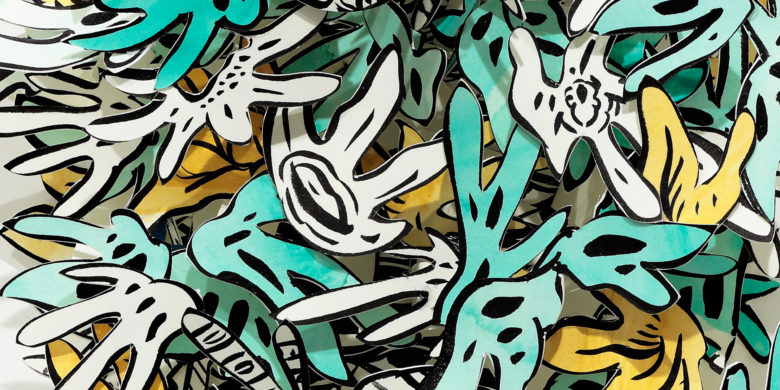
NORTH ADAMS, MASSACHUSETTS — In Maneater, Houston, Texas-based artist Natasha Bowdoin creates her largest-ever cut paper and collage installation, which investigates the intersections of the visual, the experiential, and the literary, treating language and nature as kindred phenomena. Referencing such sources as Golden Age children’s book illustrations, 19th-century botanical drawings, floral textile patterns, lunar maps, and prints of underwater sea life, Bowdoin’s fragile, lush installations shift and change as viewers explore their surfaces. Maneater is now on view in MASS MoCA’s first-floor Hunter Hallway gallery with an opening reception celebrating the work on Saturday, March 24.

Bowdoin’s affinity for the wilderness began at a young age, as she wandered the woods and waters of Maine. This wasn’t solely a physical act; she also used books to understand the landscape around her and to escape to unavailable landscapes. Primed with an empirical and a fictional experience of nature, filled with wonder and terror, Bowdoin’s work flickers between unsentimental Darwinism and embroidered reverie. Her journeys into the dark woods hark to a time when fairy tales and scientific illustrations were equally plausible explanations of nature’s mysteries: where Ernst Haeckel, Lewis Carroll, or the Brothers Grimm might all make suitable traveling companions.

In the Hunter Hallway gallery, Bowdoin’s ambitious Maneater grows to consume the space like a fruiting vine or an invasive species. As in all her work, the installation draws from many references, ranging from pop culture ideas of nature and femininity to arcane literary traditions. The title of the installation conjures the Hall & Oates’ Maneater (1982), a cautionary tale about a wild woman who will seduce you, then “chew you up.” Equally applicable is Neko Case’s People Got a Lotta Nerve (2009), which chides humans for underestimating nature — cuddly until the moment it, too, bites you back. Bowdoin is also interested in the 19th-century literary genre called “the language of flowers,” which used botanical arrangements as encrypted messages, a specific meaning assigned to each flower. These threads evoke a world in which language and nature are intertwined and potentially out to get us if we aren’t careful.

In the lush paper thicket coiling its way down the hallway, we see larger-than-life floral forms whose tranquility is undercut by carnivorous plants creeping and crawling across the gallery wall and floor. Subverting the traditional meanings ascribed to flowers — beauty, sentiment, delicacy, and femininity — Bowdoin gives the flowers back their thorns, reintroducing wildness and an unstoppable proliferation; her garden is overgrown, possibly toxic, but still seductive in its danger. She gives nature its teeth back, and the flower — beautiful but a little too abundant — becomes a feminist gesture of fight and resistance. In her interlaced references and layered forms, Bowdoin leads us into the dense, more savage precincts of the natural world, where our place in the food chain is less secure: a terrain of tooth and claw, thorn and root.

About the Artist
Natasha Bowdoin (b. 1981, West Kennebunk, ME) earned an MFA from Tyler School of Art and a BA from Brandeis University in painting and classics. She has been awarded residencies at the Core Program in Houston, TX; the Roswell Artist-in-Residence program in New Mexico; and the Bemis Center for Contemporary Art in Omaha, Nebraska. Her work has been included in exhibitions across the United States and throughout Europe, including solo exhibitions at the Visual Arts Center of Richmond, VA; Talley Dunn Gallery, Dallas, TX; Savannah College of Art and Design Museum, GA; and Monya Rowe Gallery, New York, NY; and group exhibitions at Artpace, San Antonio, TX; the Portland Museum of Art, ME; the Southeastern Center for Contemporary Art, Winston-Salem, NC; the CODA Museum, Apeldoorn, the Netherlands; and the Cue Art Foundation, New York, NY. Her work has been reviewed in publications including Artforum, BOMB, and Wallpaper* Magazine. Bowdoin lives and works in Houston, TX.

Sponsorship
Major exhibition support is provided by the Horace W. Goldsmith Foundation, the Barr Foundation, and the Massachusetts Cultural Council.

Images
High-resolution images are available through this link: bit.ly/NatashaBowdoin

About MASS MoCA
MASS MoCA is one of the world’s liveliest (and largest) centers for making, displaying, and enjoying today’s most important art, music, dance, theater, film, and video. MASS MoCA’s 250,000 sq. ft. of gallery space includes partnerships with Laurie Anderson, the Louise Bourgeois Trust, Jenny Holzer, Anselm Kiefer with the Hall Art Foundation, Sol LeWitt, and James Turrell.

Gallery admission is $20 for adults, $18 for veterans and seniors, $12 for students, $8 for children 6 to 16, and free for children 5 and under. Members are admitted free year-round. The Hall Art Foundation’s Anselm Kiefer exhibition is seasonal and will reopen on May 26 2018. For additional information: 413.662.2111 x1 or visit massmoca.org.

Hours
MASS MoCA is open from 11am to 5pm, closed Tuesdays, through June 22. From June 23 through September 3, MASS MoCA’s galleries are open seven days a week — from 10am to 6pm Sundays through Wednesdays and from 10am to 7pm Thursdays through Saturdays.
Download the Natasha Bowdoin: Maneater press release

Etel Adnan

For Immediate Release
1 February 2018
Contact: Jodi Joseph
Director of Communications
413.664.4481 x8113
jjoseph@massmoca.org


Etel Adnan: A yellow sun A green sun a yellow sun A red sun A blue sun

Arab-American artist debuts recent works in first-ever solo exhibition in U.S. museum

NORTH ADAMS, MASSACHUSETTS — In her first ever solo U.S. museum show, internationally acclaimed Arab-American artist Etel Adnan tests the limits of expression in an exhibition of leporellos, written texts, and recent works including never-before-seen paintings. A yellow sun A green sun a yellow sun A red sun A blue sun is on view beginning Saturday, April 7, with a reception to celebrate the artist and her work on Saturday, May 26.

Raised in Lebanon under the French mandate (1923-1946), Adnan was born into a fraught relationship with language. She learned French first — the language of the colonizer — before she knew Arabic, which she learned later, as an adult. Likewise, she began painting long after embarking on a literary and academic career. She is widely recognized for her poetry and prose, which for over sixty years have treated subjects including war, exile, and space travel. In 1958, while wars for independence raged in former French colonies, Adnan sought a mode of expression other than her writing in French. She began to paint and draw, as she says, “in Arabic.” A yellow sun A green sun a yellow sun A red sun A blue sun is inspired by this crucial moment in the artist’s life, which provokes the consideration of her visual arts practice as an effort of translation — from writing to painting, from French to Arabic — all in pursuit of a pure expression.

Several of Adnan’s leporellos, Japanese accordion-fold books that expand lengthwise up to fourteen feet, will be included in the exhibition. Introduced to her by an artist friend who gifted her a leporello to complete, Adnan was struck by their resemblance to scrolls, and recognized the possibility of the leporello format for experiments in hybrid media. The unique material allowed her to play with narrative form, illustrating the folded surface left to right, or ignoring the intuitive structure of the book to treat the leporello as one whole page. An example of the latter will be included in the exhibition, covered evenly in black ink drawings evocative of written marks. In her leporellos one also finds Adnan’s rare experiments in Arabic. She began by copying poems by famous Arabic authors; given that the artist does not compose in this language, her original use of Arabic script recalls its historic decorative applications in calligraphy.

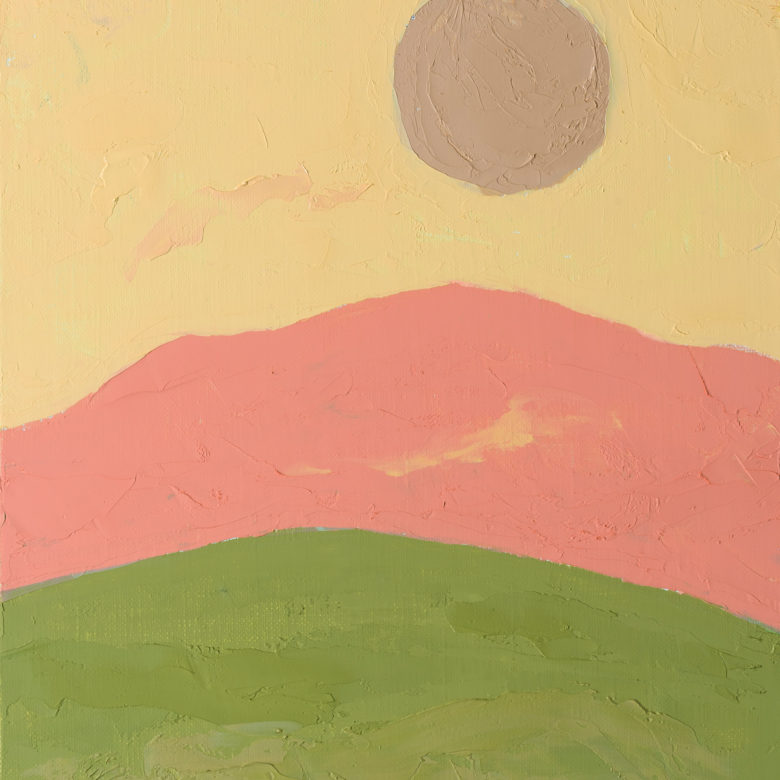
The leporellos represent the most literal bridge between the artist’s literary and visual arts practice. This exhibition suggests the poetic possibility of a similar connection in Adnan’s paintings: a dozen paintings, mostly made in the last decade, will comprise the core of the exhibition. The artist has always worked on small canvases, partially because of the way she paints. She places her canvases flush on her desk and bends over them, just as if at work on a manuscript. The paintings are recognizable for their bold formal abstraction, composed of oil paint in vivid colors applied to the canvas confidently with a palette knife, often straight from the tube. Early works were more abstract, related to one another by the presence of a red patch somewhere on the canvas. This acts as what literary theorist Roland Barthes called the punctum in photography — the detail that pulls a viewer in irresistibly, and which instantaneously organizes the picture and orients the viewer to it.

Some more recent works, like those on view in this exhibition, swap the patch of red for a sun, indexing the presence of a real-life referent — the landscape. Places dear to Adnan appear in these works, from Mount Tamalpais in northern California to the seaside in Beirut. As she has grown older and unable to travel far from her home in Paris, her abstract landscapes have taken on a fantastic, incandescent quality, charged by the artist’s imaginative longing. The paintings are made quickly, nearly unconsciously, summoned as readily as a spoken reply in a native language.

About the Artist
Etel Adnan was born in 1925 in Beirut and received her education in philosophy from the Sorbonne, the University of California, Berkeley; and Harvard. Her visual art has been shown in solo exhibitions at Serpentine Gallery, London, UK (2016); Galerie Lelong, New York, NY (2015); Mathaf Arab Museum of Modern Art, Doha, Qatar (2015); and Callicoon Fine Arts, New York, NY (2014). Her work has been included in group exhibitions at the Castello di Rivoli Museum of Contemporary Art, Rivoli, Italy (2017); the New Museum, New York, NY (2014); and dOCUMENTA (13), Kassel, Germany (2012). Her writing has been translated into over 10 languages, put to music, made into operas, and adapted for the screen. She won the Prix de l’Amitié franco-arabe for her 1977 novel Sitt Marie Rose, and was made a Chevalier de l’Ordre des Arts et des Lettres by the French government in 2014.

Images
High-resolution images are available through this link: bit.ly/EtelAdnanMM

About MASS MoCA
MASS MoCA is one of the world’s liveliest (and largest) centers for making, displaying, and enjoying today’s most important art, music, dance, theater, film, and video. MASS MoCA’s 250,000 sq. ft. of gallery space includes partnerships with Laurie Anderson, the Louise Bourgeois Trust, Jenny Holzer, Anselm Kiefer with the Hall Art Foundation, Sol LeWitt, and James Turrell.

Gallery admission is $20 for adults, $18 for veterans and seniors, $12 for students, $8 for children 6 to 16, and free for children 5 and under. Members are admitted free year-round. The Hall Art Foundation’s Anselm Kiefer exhibition is seasonal and will reopen on May 26 2018. For additional information: 413.662.2111 x1 or visit massmoca.org.

Hours
MASS MoCA is open from 11am to 5pm, closed Tuesdays, through June 22. From June 23 through September 3, MASS MoCA’s galleries are open seven days a week — from 10am to 6pm Sundays through Wednesdays and from 10am to 7pm Thursdays through Saturdays.
Download the Etel Adnan: A yellow sun A green sun a yellow sun A red sun A blue sun press release

Allison Janae Hamilton

For Immediate Release
31 January 2018
Contact: Jodi Joseph
Director of Communications
413.664.4481 x8113
jjoseph@massmoca.org


Allison Janae Hamilton: Pitch

Towering pines and taxidermied alligators transport us south in artist’s first solo museum exhibition in March 2018

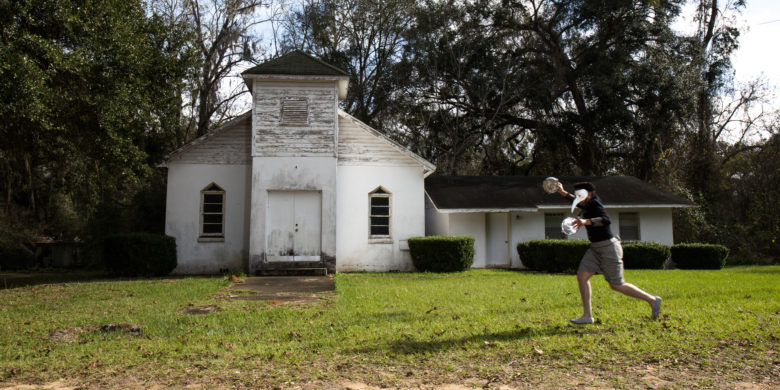
NORTH ADAMS, MASSACHUSETTS — Allison Janae Hamilton’s evocative work is influenced by the sights and sounds of the contemporary southern landscape. Her photographs, videos, sculptures, and installations feature images familiar to the north Florida and Tennessee landscapes that are home to her family: boiling swamps and tall pines, vespid wasps and green anoles, wild horses and white clapboard houses. At MASS MoCA — in her first solo museum exhibition — Hamilton presents an ensemble of existing and new works, including a new installation that looks at how history, labor, land, violence, myth, and spirituality intersect in the present. The exhibition’s title, Pitch, suggests not only the resin material of pine trees mined in the turpentine-making industry of the area, but also the myths and fables that take place in the pitch-black hours of night and an array of noises heard in the environment that inspires Hamilton, from the sounds of animals to those associated with labor and song. The exhibition opens with a reception to celebrate the artist on March 24.

Throughout Pitch, Hamilton conveys a sense of a place that is both magical and menacing — where Spanish moss decorates the knotted trees, music fills the humid air, and alligators roam the shallow waters. For Hamilton, this terrain and its inhabitants are not the stuff of fiction or gothic fantasy, but “tangible matter of palpable consequence.” In MASS MoCA’s third-floor gallery, towering, twelve-foot pine logs evoke the tall pine forests of north Florida. Wandering through the trees, the curious will find the entry to an intimate space featuring a new iteration of the artist’s video FLORIDALAND. The atmospheric, four-channel video envelops the viewer in a kaleidoscopic experience of the sights and sounds of the landscape with images of shimmering ponds, reflected clouds, and masked characters who roam the coast on horseback and dance through marshy fields. The audio is a combination of nature sounds, traditional lining hymns, noises recorded in-studio, and other sounds inspired by African-American sacred harp and shape note singing from the Florida-Alabama coast.

The installation comes alive with an array of objects that the artist has collected from the area — and altered in various ways. These include tambourines, fencing masks, horsehair, and taxidermy molds. Cast-off treasures and knick-knacks provide a glimpse into stories not often told, and add a sense of the uncanny to the environment Hamilton creates. The artist imagines that these seductive and sometimes strange relics belong to an unseen caretaker who inhabits the landscape. The world the artist creates is part fact, part fiction — flights of the imagination rooted in the real history and memories of a place. Visitors will encounter references to the literal and metaphoric scars of the pine industry and the turpentine camps (not unlike the slave plantations once located on the same land), along with the music that grew out of this labor and the resilient spirit of the workers.

The people and animals who live on this land are as important in Hamilton’s narratives as the place, and family members often populate and help produce many of her performance-based works. A selection of photographs in the exhibition features images of friends and family performing within the landscape. Churches, porches, pine trees, lakes, and fields provide the setting for imaginary tableaux that bring to mind both the dream-like images of Sally Mann and the psychologically tense portraits of Diane Arbus. In The Hours. (2015) a girl in a bright yellow dress and green hair ribbons sits on the front stoop of a house, two suitcases packed. On her head, she wears the skull and antlers of a stag that obscures her face. In Brecencia and Pheasant II. (2018), a woman dressed in her Sunday best, wearing a mask made from a fox head and feathers, holds a pheasant. Like a natural part of the forest that surrounds her, she appears, like the pheasant, to be an integral part of the ecosystem, rooted in the place.

Three commanding, full-sized alligators in the exhibition are also part of the rich Florida ecosystem and are powerful figures in Hamilton’s work. A common creature in the region and one that is both predator and food source, alligators are a symbol of the symbiotic relationships between the inhabitants of the land (the artist grew up in a family network of hunters). Twisted into circles, the alligator sculptures reference the mythical Greek ouroboros (the serpent devouring its own tail), reminding us of an eternal cycle of destruction and renewal. They also function as a tangible manifestation of other monsters that we live with, lurking but often invisible, like the racism that is most dangerous when hidden.

A mix of personal realities and epic narratives, the artist’s rich vision of the rural landscape is a lens through which she explores the intersection of agricultural, environmental, and social histories that continue to inform the present. Hamilton creates a world that is moody and complex, acknowledging the legacy of an ugly past that seeps into the present while celebrating the beauty and culture that persist.

About the Artist
Allison Janae Hamilton was born in Kentucky in 1984 and raised in Florida, and her maternal family’s farm and homestead lies in the rural flatlands of western Tennessee. She received her Ph.D. in American Studies at New York University and her MFA in Visual Arts at Columbia University where she studied with Sanford Biggers and met mentor Joan Jonas. Hamilton was a 2013-2014 Fellow at the Whitney Independent Study Program. She has exhibited at museums and institutions such as the Studio Museum in Harlem, New York, NY; Smithsonian National Portrait Gallery, Washington, D.C.; the Jewish Museum, New York, NY; the Museum of Modern Art, New York, NY; Fundación Botín, Santander, Spain; the Museum of Contemporary Photography, Chicago, IL; and the Tacoma Art Museum, Tacoma, WA. Hamilton has been awarded artist residencies at Recess, New York, NY; Fundación Botín, Santander, Spain (selected by Joan Jonas); the School of Visual Arts, New York, NY; and the Rush Arts Foundation, New York, NY. Her artwork has appeared in publications such as Transition Magazine, Women and Performance, Arte Al Limite, NKA: Journal of Contemporary African Art, and Artforum. She lives and works in New York City.

About the Curators
Susan Cross is Curator of Visual Arts at MASS MoCA.

Larry Ossei-Mensah is a Ghanaian-American independent curator and cultural critic who has organized exhibitions at a variety of venues throughout New York City, featuring artists Firelei Baez, ruby amanze, Hugo McCloud, Brendan Fernandes, and Derek Fordjour, among others. He has contributed to publications such as NeueJournal, Uptown, and Whitewall Magazine, and has written about Derrick Adams, Mickalene Thomas, Kehinde Wiley, Lorna Simpson, and street artist JR, among others. Ossei-Mensah is also the co-founder of ARTNOIR, a global collective of culturalists who design experiences aimed to engage this generation’s dynamic and diverse creative class. ARTNOIR has organized programs with artists, authors, and organizations such as Wangechi Mutu, Yaa Gyasi, Hank Willis Thomas, Knopf, Random House, The New York Times, Harvard, NYU, Tumblr, and Black Lives Matter. Ossei-Mensah was the 2017 Critic-in-Residence at Art Omi and currently serves as a mentor in the New Museum’s incubator program, NEW INC., in addition to being a member of MoMA’s Friends of Education.

Images
High-resolution images are available through this link: bit.ly/AllisonJanaeHamiltonPitch

About MASS MoCA
MASS MoCA is one of the world’s liveliest (and largest) centers for making, displaying, and enjoying today’s most important art, music, dance, theater, film, and video. MASS MoCA’s 250,000 sq. ft. of gallery space includes partnerships with Laurie Anderson, the Louise Bourgeois Trust, Jenny Holzer, Anselm Kiefer with the Hall Art Foundation, Sol LeWitt, and James Turrell.

Gallery admission is $20 for adults, $18 for veterans and seniors, $12 for students, $8 for children 6 to 16, and free for children 5 and under. Members are admitted free year-round. The Hall Art Foundation’s Anselm Kiefer exhibition is seasonal and will reopen on May 26, 2018. For additional information: 413.662.2111 x1 or visit massmoca.org.

Hours
MASS MoCA is open from 11am to 5pm, closed Tuesdays, through June 22. From June 23 through September 3, MASS MoCA’s galleries are open seven days a week — from 10am to 6pm Sundays through Wednesdays and from 10am to 7pm Thursdays through Saturdays.
Download the Allison Janae Hamilton: Pitch press release here

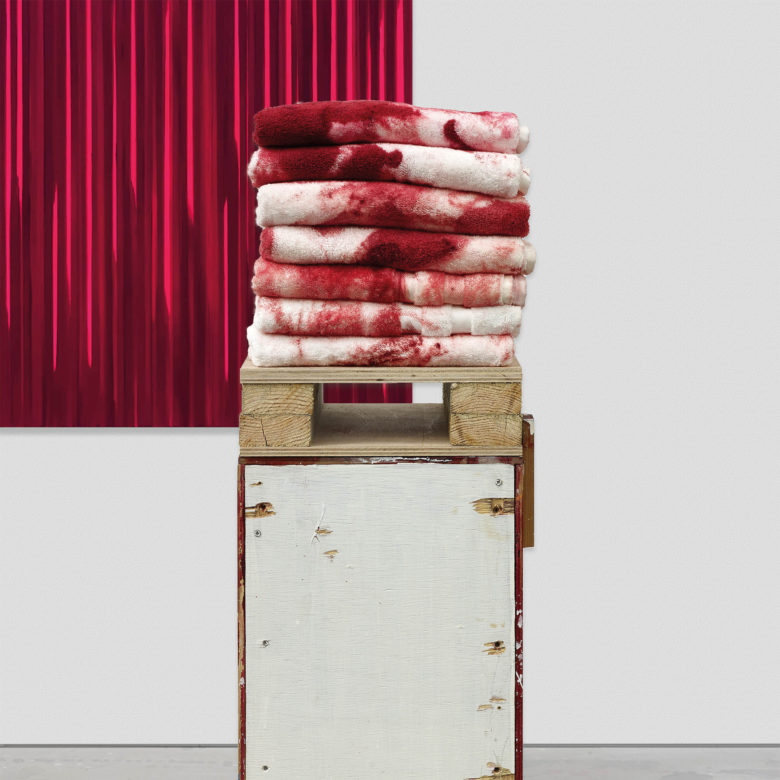
Paintings of Violence (Why I am not a mere Christian) (detail) 2011 - 2016 Oil and acrylic on canvas, wood, 7 towels, and pigment

For Immediate Release
26 January 2018
Contact: Jodi Joseph
Director of Communications
413.664.4481 x8113
jjoseph@massmoca.org


Rachel Howard: Paintings of Violence (Why I am not a mere Christian)

Eleven works mark artist’s first U.S. solo museum show

NORTH ADAMS, MASSACHUSETTS — In her first U.S. solo museum show, London-based painter Rachel Howard brings her Paintings of Violence (Why I am not a mere Christian) to MASS MoCA for its U.S. premiere. In Paintings of Violence, Howard addresses not “a bacchanalian violence, but the steady calm hand of violence on a greater scale.” The canvases in her exhibition do not so much depict violent acts as function as evidence of such actions, with deep visceral crimson oil paint dragged down a shocking pink ground. The installation, which consists of ten paintings and a single sculpture, will be on view at MASS MoCA beginning February 17, 2018, with a members’ reception on March 24.

“In real life people are cruel for one of two reasons — either because they are sadists…or else for the sake of something they are going to get out of it — money, or power, or safety. But pleasure, money, power, and safety are all, as far as they go, good things. … Wickedness, when you examine it, turns out to be the pursuit of some good in the wrong way.” – C.S. Lewis, from Mere Christianity

“Religion is based, I think, primarily and mainly upon fear… fear of the mysterious, fear of defeat, fear of death. Fear is the parent of cruelty, and therefore it is no wonder if cruelty and religion have gone hand in hand.” – Bertrand Russell, from “Why I Am Not a Christian”

Howard has long engaged with human cruelty in her practice—“When I paint about human cruelty it’s about getting things off my chest,” she says—including in the series Repetition is Truth – Via Dolorosa (2005 – 2009) and Suicide Paintings (2007). She is deeply influenced by art history and literature: in the case of Paintings of Violence (Why I am not a mere Christian), the work’s title references both C.S. Lewis’ Mere Christianity and Bertrand Russell’s “Why I am not a Christian,” texts which argue respectively for and against adherence to Christianity. Lewis wrote that Christianity is the pursuit of a life at one with God and the rest of existence—a “good” life. He characterized Christianity as a “fighting religion” which believes itself to be in the midst of a “civil war” between God and “the rebels.” According to Lewis, we are not absolutely good—that is, at one with God—and therefore God is “the only comfort.” He is also, according to Lewis’ formulation, “the supreme terror.” Russell meanwhile argued that a mutual basis in fear intimately links cruelty and religion, characterizing Christianity’s belief “that hell-fire is a punishment for sin” as “a doctrine of cruelty” responsible for centuries of violence: “the more intense has been the religion of any period,” Russell wrote, “the greater has been the cruelty.” For Russell, the best response to the “terror” of the world is to “conquer” it with “knowledge, kindliness, and courage.” Howard has described her own position as “squeezed somewhere in between” Lewis and Russell.

Paintings of Violence is the result of five years of slow, methodical work. The deliberate pace and precision of Howard’s process parallel the particular type of violence that this installation engages, which Howard has described as “maximum damage, planned and calmly carried out.” This “controlled violence” recalls holy wars and crusades, forced conversions, and shock and awe tactics. The kind of violence implicit in Howard’s paintings is not only outward-focused, but also directed towards oneself: the canvases mirror Howard’s own height and wingspan, approximately 66 inches in each direction.

Each canvas began with a grounding field of fluorescent pink, down which Howard methodically dragged strips of deep Alizarin Crimson oil paint, using a T-square to shape the precise edges. The durational relationship between Howard’s body and the canvases—a repetition of the same set of movements over the course of years—evokes the ritualized action of self-flagellation. The white towels that Howard used to wipe the excess paint from the T-square are folded neatly and stacked on a rough wooden plinth, each crusted with the colors of recently spilled blood, as though used to clean up the scene of an accident or violent crime. Together, the paintings and cloths ricochet between abstraction and performance, suggesting a violence whose vast scope hovers at the edge of imagination.

About the artist
Rachel Howard (b. 1969, Easington, County Durham, UK) graduated from Goldsmiths, University of London in 1991. She was short-listed for the Jerwood Drawing Prize in 2004, and received the British Council Award in 2008. She has had solo exhibitions at institutions including MACRO Testaccio (Rome, Italy, 2016) and Museo d’Arte Contemporanea Donnaregina (Museo MADRE) (Naples, Italy, 2011), and her work has been exhibited at the Imperial War Museum (London, UK, 2017), Sala Pelaires (Palma de Mallorca, Spain, 2017), The Drawing Room’s Drawing Biennial (London, UK, 2017 + 2015), Somerset House (London, UK, 2016), Royal Academy of Arts’ Summer Exhibition (London, UK, 2016), Ackland Art Museum (Chapel Hill, NC, 2015), and 21er Haus (Vienna, AT, 2015), among many others. Howard’s upcoming exhibitions include Rachel Howard, Der Kuss, Blain|Southern ‪(London, UK, January 24 – March 17, 2018) and Repetition is Truth – Via Dolorosa, Newport Street Gallery (London, UK, March 21 – May 2018). She lives and works in London and Gloucestershire, and is represented by Blain|Southern. https://www.rachelhoward.co.uk/

Images
High-resolution images are available here

About MASS MoCA
MASS MoCA is one of the world’s liveliest (and largest) centers for making, displaying, and enjoying today’s most important art, music, dance, theater, film, and video. MASS MoCA’s more than 250,000 sq. ft. of gallery space includes partnerships with Laurie Anderson, the Louise Bourgeois Trust, Jenny Holzer, Anselm Kiefer with the Hall Art Foundation, Sol LeWitt, and James Turrell.

Gallery admission is $20 for adults, $18 for veterans and seniors, $12 for students, $8 for children 6 to 16, and free for children 5 and under. Members are admitted free year-round. The Hall Art Foundation’s Anselm Kiefer exhibition is seasonal and will reopen in May 2018. For additional information:

413.662.2111 x1 or visit massmoca.org.

Hours
MASS MoCA is open from 11am to 5pm, closed Tuesdays through June 22. From June 23 through September 3, MASS MoCA’s galleries are open seven days a week — from 10am to 6pm Sundays through Wednesdays and from 10am to 7pm Thursdays through Saturdays.
Download the Rachel Howard: Paintings of Violence (Why I am not a mere Christian) press release.

For Immediate Release
21 August 2017
Contact: Jodi Joseph
Director of Communications
413.664.4481 x8113
jjoseph@massmoca.org


Liz Glynn: The Archaeology of Another Possible Future

NORTH ADAMS, MASSACHUSETTS — Los Angeles-based Liz Glynn will present her largest and most ambitious project to date in Building 5, MASS MoCA’s largest gallery — a sprawling multi-sensory sculptural experience of sight, sensation, sound, and scent stretching nearly a football field in length. The Archaeology of Another Possible Future expands Glynn’s interest in the rise and fall of empires, labor, and shifting cultural values, in order to speculate upon our uncertain future. The multi-level presentation in the museum’s former factory space examines the loss of material economies in the wake of digital commerce, robotic manufacturing, and the rise of the service sector. The Archaeology of Another Possible Future will open on October 8, 2017, with a reception for the artist and members on Saturday, October 7, from 5:30 to 7:30pm. The exhibition will remain on view through Labor Day 2018.

Glynn’s MASS MoCA exhibition responds to an economy, in the artist’s words, in which “technology companies seem to generate billion-dollar valuations out of thin air, nanotechnology operates beyond the field of the visually apprehensible, and capital is accumulated as pure concept.” In this increasingly virtual world, Glynn seeks to reconcile the presence of physical bodies and individual subjectivities, emphasizing the experience of physical movement through space in real time. The show unfolds in five chapters and two appendixes, opening with primitive sensory experiences and culminating in the glistening image of a postindustrial economy.

The labyrinthine exhibition opens with three caves made of shipping pallets — pyramids, within which visitors discover intimate sensory experiences of touch, sound, and scent. Highlights of the Analog Caves include accumulations of industrial felt and hanging stalactites that engulf viewers in a cushiony maze; slip-cast ceramic vessels in the altered shape of platonic solids, each containing an evocative smell; and an analog vinyl record produced for the exhibition with no digital processing. For the second chapter of the exhibition, The Shape of Progress, Glynn has created a series of formally abstract sculptures made from contemporary materials and industrial detritus that translate theories of historical progression and data — often visualized as graphs or charts — into three-dimensional forms scaled to the human body.  As in many of Glynn’s works and values, material becomes a catalyst to question the nature of historical progress. A sculpture housing live monarch butterflies references the butterfly effect as applied to world economics. The third chapter of the exhibition features three shipping containers in hues of red, green, and blue. The containers house three distinct installations, including a series of plans for failed inventions and obsolete technologies, videos exploring different speculative visions of the future, and a job-site office recalling those of a bygone era. Emblazoned with the names of Capital Intermodal and the now bankrupt Hanjin shipping company, the containers function as relics of a global economy in acute transition. Periodically, the containers will house “caretakers” who, drawing from their personal experience in manufacturing or industry, will explain how things work.

Progressing to the fourth chapter of the installation, The Age of Ephemeralization, a system of catwalks places visitors high above the gallery floor. Viewers can access the raised pathway via the mezzanine gallery or stairs that lead up from the ground floor to three scaffolding towers, where industrial 3-D printers developed by Formlabs will produce objects designed by Glynn. Visitors traversing the upper levels will have a bird’s eye view of the industrial artifacts below — a precarious perspective evoking the spectacle (and fear) of the new dematerialized economy. With this shift in vantage points, the viewer might consider our recent history as an archaeology of all the “stuff” that will cease to exist in the digital age. Below the catwalks, in a final chapter, lies a dystopic, postindustrial vacationland for the workers whose labor has become obsolete, inspired in part by Aldous Huxley’s writings about a future era of automated labor. The installation features a series of sculpturally modified stainless steel stretchers-cum-lounge chairs and cast stainless steel tumbleweeds. What will we do, the show asks, if robots do it all for us?

The exhibition continues with two “footnotes,” which include a timeline of 3-D printed tools — dating from prehistory through the industrial revolution — sculpted by hand, scanned, and output with a 3-D printer. Highlighting the notion of technology as an extension of the hand, the timeline acts to join the two worlds built within the exhibition. In a second-floor gallery — reached at the end of the visitor’s exploration of the installation or via the catwalks suspended in the main gallery — Glynn will present stacks of newsprint posters, which visitors are invited to take. The posters are printed with images and text offering questions and statements about the nature of human control and the position of the human body within an advanced technological society.

Publication
In conjunction with the exhibition, MASS MoCA will publish the first monograph of Glynn’s work in association with DelMonico Books/Prestel. Liz Glynn: Objects & Actions features images and texts documenting sculptures, installations, and performative works made by the artist over the past decade, including the installation at MASS MoCA. The lavishly illustrated publication will also feature essays by MASS MoCA Curator Susan Cross; Connie Butler, Chief Curator at the Hammer Museum, Los Angeles; and José Luis Blondet, Curator of Special Projects at LACMA, Los Angeles. The monograph is designed by Jessica Fleischmann of still room studio, Los Angeles.

About The Artist
Liz Glynn was born in Boston, Mass., in 1981. She received her B.A. from Harvard College in 2003, and her M.F.A. from the California Institute of Arts in 2008. She has presented exhibitions, participatory performances, and installations across the U.S. and Europe. Most recently, she created Open House, an installation for the Public Art Fund in New York City’s Central Park. She has had solo exhibitions at LACMA (2015), which grew out of an earlier series of performances exploring monumental works of sculpture in the museum’s collection. Her work has been the subject of numerous solo exhibitions, including SculptureCenter, New York (2014); Artpace, San Antonio (2014); MOCA, Los Angeles (2011); and Arthouse, Austin (2009). Glynn’s work has been included in group exhibitions, including Pacific Standard Time organized by the Getty Research Institute, Los Angeles (2012); migrating public art project Station to Station (2013); Made in LA at the Hammer Museum, Los Angeles (2012); Performa 11, New York (2011); and The Generational: Younger Than Jesus at the New Museum, New York (2009). Glynn is represented by Paula Cooper Gallery, New York. She lives and works in Los Angeles.

Sponsorship
Major exhibition support is provided by The Andy Warhol Foundation for the Visual Arts, the National Endowment for the Arts, Formlabs, Girardi Distributors LLC, Horace W. Goldsmith Foundation, the Barr Foundation, the Massachusetts Cultural Council, Guido’s Fresh Marketplace, and The Berkshire Eagle.

Exhibitions of emerging artists are made possible in part by the Anna-Maria and Stephen Kellen Foundation.

Images
A collection of high-resolution images is available here.

About MASS MoCA
MASS MoCA is one of the world’s liveliest (and largest) centers for making, displaying, and enjoying today’s most important art, music, dance, theater, film, and video. MASS MoCA nearly doubled its gallery space in spring 2017, with artist partnerships that include Laurie Anderson, the Louise Bourgeois Trust, Jenny Holzer, the Robert Rauschenberg Foundation, and James Turrell.

Gallery admission is $20 for adults, $18 for veterans and seniors, $12 for students, $8 for children 6 to 16, and free for children 5 and under. Members are admitted free year-round. The Hall Art Foundation’s Anselm Kiefer exhibition is seasonal and currently on view. For additional information, call 413.662.2111 x1 or visit massmoca.org.

Summer Hours (through September 4)
10am to 6pm, Sundays–-Wednesdays 10am to 7pm, Thursdays–-Saturdays

Download the Liz Glynn: The Archaeology of Another Possible Future press release.

sarah-braman-abstract

For Immediate Release
12 April 2017
Contact: Jodi Joseph
Director of Communications
413.664.4481 x8113
jjoseph@massmoca.org

In the Abstract

11 artists tackle sociopolitical realities through new works of contemporary abstractions

NORTH ADAMS, MASSACHUSETTS — In the Abstract brings together a mix of multi-generational artists whose works represent a potent and muscular approach to contemporary abstraction that adopts and adapts various formal strategies of painting — from hard-edge geometries and dense color blocks to gauzy color fields and expressionist marks — with that of sculpture, photography, digital processes, and video. This selection of artists engages the formal language of abstract painting in various mediums, along with more representational strategies. Color, gesture, and geometric form join with recognizable imagery and objects, as well as references to the figure. In The Abstract, which opens in MASS MoCA’s first-floor galleries on Saturday, May 6, with a reception for the artists from 5:30 to 7pm, will remain on view through March 2018.

The exhibition includes the works of Doug Ashford, Aidas Bareikis, Sarah Braman, Tomashi Jackson, Rosy Keyser, Eric N. Mack, Rose Marcus, Rodney McMillian, Matt Saunders, Letha Wilson, and Brenna Youngblood. Many of the artists — including Ashford, Jackson, Keyser, and Saunders — have made new works for the show. The presentation features the U.S. debut of an 80-foot long painting by Rodney McMillian — created for the 12th Sharjah Biennial and which visitors experience as a tunnel — as well as an installation of tempera paintings and related photographic images by Doug Ashford, previously presented at Documenta 13.

For these artists, the abstract vocabularies act as a metaphor for a way of thinking, or as an emotional, psychological, or spiritual lens through which to understand our everyday social and political realities, including issues of gender inequity, racial injustice, and the state of the environment. The references to intangible states, forces, and systems are as significant and as real as the more concrete or representational elements in the work.

Abstraction has been a dominant force in the art of the last century, though it has waxed and waned in significance and popularity, and in its relationship to representation. Since its beginnings in the early 1900s, abstraction has taken various forms and positions — drawing lines and defining territories between “non-objective art“ and works that are abstracted from or rooted in reality. In the Abstract looks to artists whose works confirm the significance and potential of abstraction as a form of communication beyond language that can both convey inner states and make manifest the abstraction of exterior realities that shape daily experiences — and as a vehicle for social and political change.

As its title suggests, In the Abstract points to a connection between ways of thinking and visual strategies of representation. Without a rigid thesis dictating the meaning of the works themselves or the relationships between them, the exhibition points to the potential of abstraction to evoke ideas and emotion —and make manifest the digestion of reality — with a nod to abstraction’s historical associations with social, political, and spiritual transformations, reminding us that the Constructivist, Bauhaus, and Neo-Concrete movements, for example, were deeply imbued with political and social aspiration.

About the Artists

Doug Ashford (b. 1958, Rabat, Morocco) is known for his pedagogy and his participation in the artist collaborative Group Material, whose projects and exhibitions in the 1980s and ‘90s were concerned with participation, social potential, and forms of display and public expression. Recently, Ashford has turned to painting, pairing images sourced from the news with abstract forms and color that the artist proposes as a reservoir for individual and shared emotions that function as instruments for political resistance and reform.

Aidas Bareikis (b. 1967, Vilnius, Lithuania) creates condensed but unruly assemblages of ready-made objects that he fuses together and transforms with splatters, pours, and thick layers of paint. Trained as a painter, Bareikis uses muddy browns, tropical blues, and acid oranges — both applied and within the components themselves — to simultaneously animate and disguise the lurid, sometimes humorous combinations. These shape-shifting products of the Anthropocene age take on both anthropomorphic and geological appearances, along with art historical allusions. Sneakers, hats, broken chrome chairs, out-of-date globes, suitcases, and trash suggest the digestion and detritus of everyday domestic life, as well as larger economic, ecological, and even geopolitical systems.

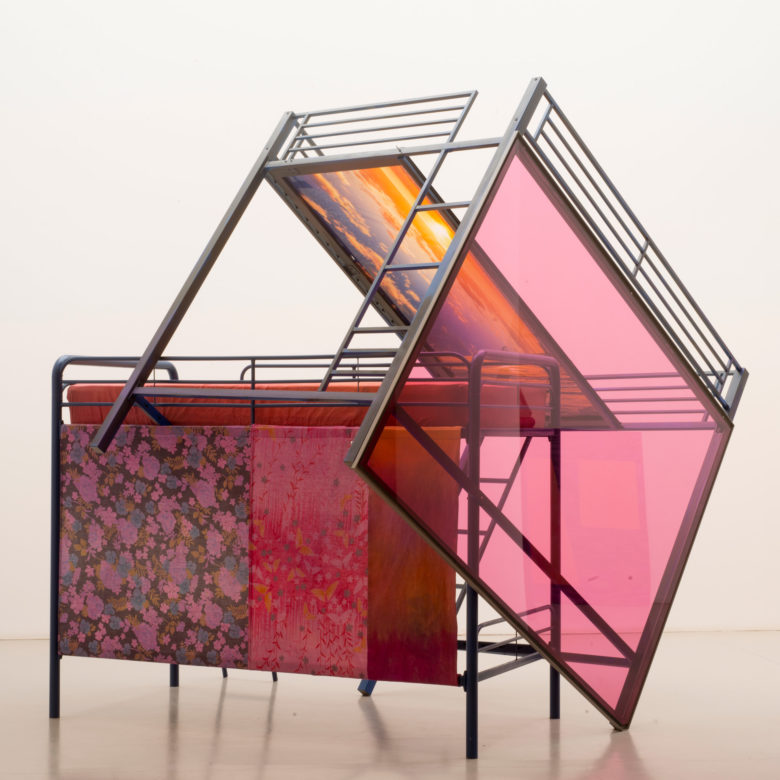
Sarah Braman (b. 1970, Tonawanda, NY, lives in Amherst, MA) repurposes scavenged objects such as cars, bunk beds, and screen doors in large-scale geometric assemblages. Incorporating glass and plexiglass panels in pinks, purples, and oranges, she suffuses her works with the range of color and emotion embedded in our everyday experience. With titles such as In Bed (how do we sleep when the world is melting?), they often point to the intersection of the domestic sphere and the issues troubling the world at large.

Tomashi Jackson (b. 1980, Houston, TX) merges color and pattern with historic and contemporary images in exuberant collage-like abstract paintings that grapple with the systems that foster racism. Influenced by Barnett Newman’s writings on the sublime, Jackson’s research-based practice draws parallels between formal and social issues related to color, while embracing the transformative power of art. Painting on humble materials, including gauze, she asks questions about both value and beauty in art and society at large, while her dynamic and colorful videos confront viewers head-on with gut-wrenching visions of violence and systems of power.

Rosy Keyser (b. 1974, Baltimore, MD) is best known for gritty, large-scale paintings that are as metaphysical as they are physical. Incorporating evocative objects and materials that include sandbags, sawdust, spray paint, and beaded car-seat covers, the dense works obliquely suggest the figure and explore — in the artist’s words — “our compulsions, scope of awareness, and stamina straddling the strange worlds of mind and matter.”

Eric N. Mack (b. 1987, Columbia, MD) combines clothes, blankets, rugs, and other found objects and textiles into painterly assemblages that are often precariously hung or draped in architectonic compositions. Mack integrates the everyday into these layered, expressionist “canvases” adding pages torn from magazines and newspapers along with washes of color, paint splatters, and dots of paint pushed through pegboard in a DIY screen-printing process. Adapting jackets, jumpsuits, and shirts with grommets, safety pins, and visible stitching, Mack harnesses the energy of both fashion and the street, while powerfully evoking the body and its vulnerability.

Rose Marcus (b. 1982, Atlanta, GA) uses multiple materials to transform matter-of-fact photographs of New York City locales — including Central Park and the John Lennon memorial — into layered abstract compositions. Influenced by the work of Robert Motherwell and Helen Frankenthaler, Marcus applies a variety of marks and gestures to her photographs with cuts through the support, as well as colorful overlays of fabric that suggest the many invisible relationships, emotions, and narratives embedded in these spaces and how they are used by the public.

Rodney McMillian (b. 1969, Columbia, SC) works in multiple modes, from sculpture to video, performance, and painting, including compositions on bedsheets that engage ideas in abstraction yet simultaneously invoke representations of the body and the landscape. Incorporating objects such as couches, refrigerators, and carpets into many of his works, as well as references to current and historical political events, McMillian makes connections between the domestic and the public spheres as he manifests the maze of legislative, linguistic, and visual strategies that construct race and class in America.

Matt Saunders (b. 1975, Tacoma, WA) is best known for process-based works that merge painting with photography, video, and animation. Projecting light through “negatives“ painted on linen and mylar, Saunders produces moving collages of image and abstraction. Often working from found film sources, the artist manipulates and disrupts narrative fragments to produce colorful, abstract reveries. For MASS MoCA, Saunders creates a new iteration of his multi-channel video installation Reverdy / King Hu (2014).

Letha Wilson (b. 1976, Honolulu, HI) merges images of the American landscape with poured concrete in multi-layered photo-based works that are both ecstatically colorful and rough and raw. Using printing techniques as well as sculptural processes, Wilson confounds not only nature and industry but also image and object. For MASS MoCA, Wilson is creating several new works, including her largest tondo date.

Brenna Youngblood (b. 1979, Riverside, CA) incorporates her own photographs, representational fragments, and found objects, such as wallpaper and book pages, into her textured, atmospheric paintings that read between pure abstraction and a slice of life. Using a mix of bright colors and more muted tones, as well as thin washes and thick layers of paint, Youngblood builds up complex, spatially ambiguous surfaces that in her words “mimic objects, materials, and things from the real world.” Iconic images and forms such as light switches, tree-shaped air fresheners, and pyramids recur in many works, creating an archeology of objects and symbols that hover between the existential and the everyday.

Sponsorship
Principal exhibition support is provided by Greg and Anne Avis. Major exhibition support is provided by the Horace W. Goldsmith Foundation, the Barr Foundation, and the Massachusetts Cultural Council.

Images
A collection of high-resolution images is available here.

About MASS MoCA
MASS MoCA is one of the world’s liveliest (and largest) centers for making, displaying, and enjoying today’s most important art, music, dance, theater, film, and video. MASS MoCA will nearly double its gallery space in spring 2017,with artist partnerships that include Laurie Anderson, the Louise Bourgeois Trust, Jenny Holzer, the Robert Rauschenberg Foundation, and James Turrell.

Gallery admission is $18 for adults, $16 for veterans and seniors, $12 for students, $8 for children 6 to 16, and free for children 5 and under through May 21, 2017. Members are admitted free year-round. The Hall Art Foundation’s Anselm Kiefer exhibition is seasonal and reopens on April 15, 2017. For additional information, call 413.662.2111 x1 or visit massmoca.org.

Hours
11am to 5pm, closed Tuesdays
(open Tuesday, April 18)

Summer Hours (beginning June 24)
10am to 6pm, Sundays – Wednesdays
10am to 7pm, Thursdays – Saturdays

Download the In the Abstract press release.

cavernous

For Immediate Release
28 February 2017
Contact: Jodi Joseph
Director of Communications
413.664.4481 x8113
jjoseph@massmoca.org

Cavernous: The Inner Life of Courage

Kidspace exhibition features artist Wes Sam-Bruce

NORTH ADAMS, MASSACHUSETTS — On June 17, 2017, Kidspace opens Cavernous: The Inner Life of Courage, Colorado-based artist Wes Sam-Bruce’s lively installation that uses the Hoosac Tunnel as a metaphor for brave endeavors. The Kidspace gallery will explore what it takes to be courageous and persevere in the face of mountain-sized obstacles. Visitors are invited to play in a tunnel-like structure built specifically for the museum. A free opening celebration takes place with the artist on Saturday, June 17, from 11am to 1pm.

Sam-Bruce, renowned for producing interactive artworks, found the North Adams icon to be a fascinating historical site to explore. According to the artist, “The Hoosac Tunnel construction can be viewed as a representation of an act of courageousness: a journey through the unknown — dark, cavernous, difficult, loss, successful, light-giving, connecting, a triumph, tenacity, and grit.” Being central to the North Adams community, he views the tunnel as a symbol of the legacy of a group of people who then and now have acted courageously through the many chapters of the city’s history.

Sam-Bruce will spend a month in residency at the museum conducting local history research and building an artwork that will feature a cavernous mountain, tunnels, and thresholds. Visitors can make their way through the installation, an uncharted space composed of repurposed wood, text, and drawings, finding themselves surrounded by content that delves into the human experience; they have not only entered the mountain, but also, as Sam-Bruce puts it, “the space of one’s innermost self — the root of courage.”

“For the courage-themed exhibition, I was looking for an artist who could construct a bold work of art that would enable visitors to play, take risks, and perhaps bring out the audacious aspect of their inner selves,” Director of Education and Kidspace Curator Laura Thompson notes. “Courage is sometimes viewed in idealistic terms such as hero-worshipping and visions of utopia. Wes recognizes the challenges that may arise that discourage everyday brave acts. Using a wide range of materials and storytelling techniques, Wes’ tunnel will realize a paradise for children to imagine the possibilities for productive and peaceful communities.”

Visitors can flex their “courageous muscles” throughout the exhibition, and further test them at the Kidspace ArtBar in various art-making activities for all ages, from creating their own sculptures to playing with materials such as clay and paint. The ArtBar also includes a series of tabletop play elements — mountains, houses, trees, and scaled figures (similar to a model train set) — so that visitors can continue to play and engage with the exhibition. They can also create their own miniature mountain cabins to either take home or contribute to the set.

Cavernous is the third component of Kidspace’s Art 4 Change, a four-year project that explores problem-solving through empathy, optimism, and courage. The guiding principle for these exhibition projects is Albert Einstein’s statement that “[We] cannot solve our problems with the same thinking we used when we created them.” In other words, without empathy, hope, and courage, societal problems can seem overwhelming. In an era of narcissism and cynicism, therefore, an experience with Sam-Bruce’s work provides the opportunity to strengthen our collective sense of bravery, tolerance, and kindness.

The free opening celebration takes place on Saturday, June 17, from 11am to 1pm. Meet the artist, make some art, and enjoy some refreshments. Admission to Kidspace is always free; the ArtBar is open on weekends and during school breaks.

About the Artist
Wes Sam-Bruce is an artist, educator, designer, writer, and poet. He’s best known for his exploratory and story-soaked sculptural installations. Like entering another world, abandoned home, cavern system, or one’s own inner life, his installations act as living metaphors to prompt physical engagement and character development with the viewer. They also conjure strong emotional connections, empower self and world awareness, offer insight into the human condition, and enchant authentic and imaginative play in both adults and children.

Ranging from vast village-like installations in partnership with museums and dynamic communities, to the small act of writing a poem or taking photographs alone at a river, Sam-Bruce’s work investigates the nuance of the human experience, mystery, connections to language, landscape and place, the unfathomable depths of our inner lives, and the threaded-ness of a single thing to everything else. His work has many mediums, the ideas taking their final physical form to fill in the open space of a gallery wall, installation, or poem.

Previous collaborators include the Museum of Contemporary Art San Diego, CA; Museum of Contemporary Art Denver, CO; the Institute of Contemporary Art, Boston, MA; Maui Arts & Cultural Center, HI; and The New Children’s Museum, San Diego, CA; as well as many different community centers, various schools, the river next to his house, the forest behind his childhood home, and many other known and unknown people, places, and things.

Images
A collection of high-resolution images is available here.

Sponsorship
Core education funding is provided by the W.L.S. Spencer Foundation.

Education at MASS MoCA is made possible in part by the Institute of Museum and Library Services. Additional support is provided by the National Endowment for the Arts, Milton and Dorothy Sarnoff Raymond Foundation, Holly Swett, Feigenbaum Foundation, John DeRosa, Ruth E. Proud Charitable Trust, Hemera Foundation, MountainOne, Massachusetts Cultural Council, Bessie Pappas Charitable Foundation, Charles H. Hall Foundation, Adelard A. Roy and Valeda Lea Roy Foundation, the Gateway Fund and the William and Margery Barrett Fund of the Berkshire Taconic Community Foundation, John F. and Judith B. Remondi, and an anonymous donor.

The Milton and Dorothy Sarnoff Raymond Foundation gives in memory of Sandy and Lynn Laitman.

About MASS MoCA
MASS MoCA is one of the world’s liveliest (and largest) centers for making, displaying, and enjoying today’s most important art, music, dance, theater, film, and video. MASS MoCA will nearly double its gallery space on May 26, 2017, with artist partnerships that include Laurie Anderson, the Louise Bourgeois Trust, Jenny Holzer, the Robert Rauschenberg Foundation, and James Turrell.

Gallery admission is $18 for adults, $16 for veterans and seniors, $12 for students, $8 for children 6 to 16, and free for children 5 and under, through May 21, 2017. Beginning May 22, gallery admission will be $20 for adults, $18 for veterans and seniors, $12 for students, $8 for children 6 to 16, and free for children 5 and under. Members are admitted free year-round. The Hall Art Foundation’s Anselm Kiefer exhibition is open seasonally, spring – fall. For additional information, call 413.662.2111 x1 or visit massmoca.org.

Hours
11am to 5pm, closed Tuesdays

Summer Hours (beginning June 24)
10am to 6pm, Sundays–Wednesdays
10am to 7pm, Thursdays–Saturdays

Download the Cavernous: The Inner Life of Courage press release.

For Immediate Release
14 December 2016
Contact: Jodi Joseph
Director of Communications
413.664.4481 x8113
jjoseph@massmoca.org

Tanja Hollander: Are you really my friend?

A document of friendship in the age of social media is the artist’s largest-ever solo museum show

NORTH ADAMS, MASSACHUSETTS — In February 2011, Maine-based artist Tanja Hollander set out to photograph 626 of her Facebook friends in their homes around the world. In June 2015, her final 430th portrait was made in Tel Aviv, after traveling to 4 continents, 12 countries, 34 states, 180 cities/towns, 260 zip codes, and 424 homes. This working project evolved into a multimedia art experience that records how we all reshape our lives through photography and digital experiences. Are you really my friend? opens at MASS MoCA on Saturday, February 18, and an opening reception will be held on Saturday, March 18, from 5:30pm to 7pm, in conjunction with openings for new exhibitions by Liz King, Steffani Jemison, and Chris Domenick.

In Are you really my friend? Hollander delves into themes of privacy, contemporary culture, family structure, social networking, and human relationships in the 21st century. She examines both our on-line and off-line experiences, and incorporates the ideas of compassion and empathy into our modern-day experiences. Ultimately, Hollander intends for the exhibition to be a “collection of portraits that create a window into the home as each subject defines it, a collection of multi-generational and demographic views on friendship, and a slice of life on the road as a lady artist for over 5 years.”

Are you really my friend? features 430 portraits of Hollander’s Facebook friends, landscapes of the places she traveled, snapshots of what she discovered along the way, thousands of images of travel ephemera (such as boarding passes, receipts, gifts, notes, etc.), and a short documentary about the project directed by Robin Greenspun. Additionally, partway through the project, Hollander also began collecting Post-it notes asking people to answer the question, “What is a real friend?” She has collected thousands of these across the world and held two collection sessions at MASS MoCA during the 2015 Solid Sound and FreshGrass music festivals. Visitors to Hollander’s exhibition will be able to add their own Post-it musings on friendship throughout the run of the show.

About the Artist
Tanja Alexia Hollander (b. 1972, St. Louis, Missouri) received a B.A. in photography, film, and feminist studies from Hampshire College in 1994. Selections from Are you really my friend? have been exhibited at the Portland Museum of Art, Maine; Virei Viral, Rio de Janeiro, Brazil; and the Deutsches Hygiene-Museum, Dresden, Germany. Receiving international media attention for the project, Hollander was invited to give a TEDxDirigo talk in 2012, and has lectured extensively at Demanio Marittimo.KM-278, Marzocca, Italy; the University of Maryland; Clemson University; SXSW; and Facebook headquarters. Hollander is represented by Carroll and Sons in Boston, Massachusetts. She is currently a resident of Auburn, Maine.

Sponsorship
Principal exhibition support is provided by the Horace W. Goldsmith Foundation, the Barr Foundation, National Endowment for the Arts, the Massachusetts Cultural Council, Designtex, and Color Services, LLC. Major exhibition support is provided by Joey and Ragnar Horn and Caroline Niemczyk.

Images
A collection of high-resolution images is available here.

About MASS MoCA
MASS MoCA is one of the world’s liveliest (and largest) centers for making, displaying, and enjoying today’s most important art, music, dance, theater, film, and video. MASS MoCA will nearly double its gallery space in spring 2017, with artist partnerships that include Laurie Anderson, the Louise Bourgeois Trust, Jenny Holzer, the Robert Rauschenberg Foundation, and James Turrell.

Gallery admission is $18 for adults, $16 for veterans and seniors, $12 for students, $8 for children 6 to 16, and free for children 5 and under through May 21, 2017. Members are admitted free year-round. The Hall Art Foundation’s Anselm Kiefer exhibition is open seasonally, spring – fall. For additional information, call 413.662.2111 x1 or visit massmoca.org.

Hours
11am to 5pm, closed Tuesdays

Download the Tanja Hollander press release.

  • « Previous Page
  • 1
  • …
  • 3
  • 4
  • 5
  • 6
  • 7
  • Next Page »

TAKE PART

Newsletter sign-up
Mass MoCA Instagram Mass MoCA Facebook Mass MoCA YouTube
LOGIN ABOUT HOST EVENTS / OFFICE SPACE PRIVACY POLICY Consent Policy

MASS MoCA

1040 MASS MoCA WAY
North Adams, MA 01247

413.662.2111

info@massmoca.org

Copyright © 2025 Massachusetts Museum of Contemporary Art

Barr Foundation Massachusetts Office of Travel & Tourism
Consent Preferences