About Kidspace
ABOUT KIDSPACE
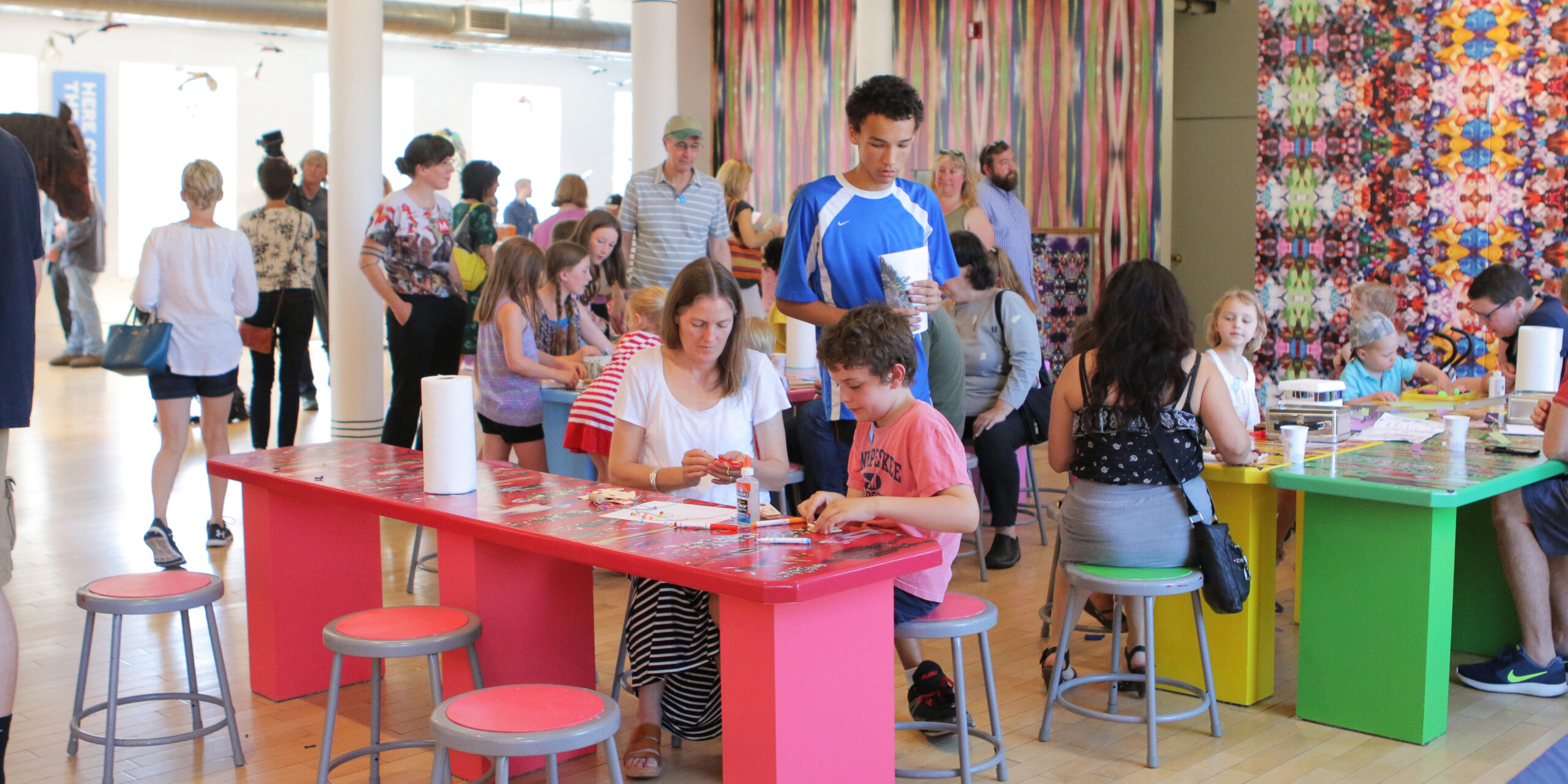
Kidspace is a creative makerspace at MASS MoCA centering experiential learning and engagement in the arts for all. Here you can learn about and make art with your friends, family, and MASS MoCA Museum Educators. Our Educators use MASS MoCA’s rich array of exhibitions, performances, and artist residencies as starting points to inspire your own creative reflection and self-expression. Whatever way you choose to engage in Kidspace, we hope it inspires you and nurtures your creativity, and that you will share what you have made and learned with others.
Kidspace is open during museum hours. Admission to Kidspace and artmaking is always free and open to all ages and abilities. Explore our many educational offerings, learn something new, and make art with us!
ARTBAR & COMMUNITY ART PROJECTS
We offer individual art projects, collaborative community art projects, as well as Art Explorer Kits for our youngest visitors and those with varying abilities. ArtBar and Community Art Projects rotate every 3-6 months so there is always something new. Be sure to also check out the book nook and puppet theater when you visit! Please note that caregivers should stay with their children at all times while in Kidspace.
GROUPS
In order for us to best serve you, we require reservations for artmaking for groups of 10 or more who wish to visit Kidspace and make art together. The fee is $5 per person which covers the supplies as well as a Museum Educator to facilitate the project with your group. Small groups are welcome to visit Kidspace without charge in groups of less than 10 at a time. To make a reservation for your group please email studentgroups@massmoca.org.
FAMILY STORYTIME
Family Storytime is an opportunity to visit the museum with children up to 6 years old and join MASS MoCA Museum Educators for a storytime and related exploration in the galleries. Each storytime features a different children’s book about contemporary art, creativity, and/or the themes of the exhibitions on display. A brief gallery walk-through and discussion of the art will follow. This program is in partnership with the North Adams Public Library.
Free; RSVP to reserve your spot. Please note that caregivers should stay with their children at all times. Older siblings are welcome to attend.
At this time we cannot accommodate large groups in storytime. To arrange a group visit to the museum and discuss educational components that could be included in your visit, please contact studentgroups@massmoca.org.
DCF: FAMILY VISITS
Families and social workers are welcome to use the Kidspace Classroom and explore MASS MoCA’s galleries for supervised visits and/or a kid-friendly place to gather during regular museum hours. Reservations for the classroom and to visit the museum are required (and free!), please email education@massmoca.org or call (413) 664-4481 x8165 to reserve your time.
Core education funding is provided by the W.L.S. Spencer Foundation and Mass Cultural Council.