On view February 21, 2026 through Spring 2027
The Robert W. Wilson Building (B6.3)
Opening Celebration, Saturday, February 21, 2026 at 5:30pm
Press Images
North Adams, MA, November 3, 2025 — Responding to the rapidly advancing technologies that are shaping our daily lives and social fabric, the artists in Technologies of Relation examine how we relate to each other, to machines, and to our future – often by looking to lessons from the past. These creators see the complexity of our relationships to the digital, avoiding the binary views that frame technology as good or bad, as tool or monster Instead they acknowledge how technology, from algorithms to Artificial Intelligence, is used in ways that manipulate, marginalize, and oppress us; but imagine both how we can resist and how these tools can be wielded more ethically and more poetically.
Exhibiting artists include: Morehshin Allahyari; Pelenakeke Brown; Taeyoon Choi; Neema Githere; Mashinka Firunts Hakopian, Dahlia Elsayed, Andrew Demirjian, and Danny Snelson; Kite; Lauren Lee McCarthy; Analia Saban; and Roopa Vasudevan.
“Artists have long been key to identifying the colonialist logic, racism, and violence embedded in and produced by corporate-dominated technologies and datasets in addition to offering a vision of a technological future that is inclusive and liberatory,” said Susan Cross, MASS MoCA’s Director of Curatorial Affairs and the curator of the exhibition. “The artists in the exhibition demystify technology, reminding us that it is neither neutral, nor authoritative, or beyond our scope of influence. Though most are skilled technologists, they often choose simple materials to give shape to their ideas and work across mediums, addressing technology both with its own tools and through analog means.”
Artists in the exhibition envision technology as a vehicle for connection, care, and equity, while inverting assumptions of digital technology’s hold over our lives by illuminating its reciprocal relationship to humans. They bring it even closer by relating emerging technologies to the ancient arts of writing, weaving, tattooing, and divination, using these models of transformative, but accessible technologies as vehicles for imagining (or remembering) how we can employ more ethics and care in the technological sphere.
With his work Interweaving Poetic Code, 2021, which includes three jacquard-knit banners, Taeyoon Choi emphasizes the historical relationship between computing and textile machinery, while referencing the museum’s history as a textile mill. The jacquard loom is considered a predecessor to the modern computer because of its use of a binary system and punch cards to program the loom. Choi’s textiles, produced on an industrial knitting machine, are embedded with patterns of binary alphabet code. When decoded, the message reads “Absence is Presence with Distance,” a phrase derived from a text exchange between Choi and artist Christine Sun Kim. In the artist’s words, “the work gives form to the tactile language of textiles with the abstract nature of computation.”
In his new series Towards the Uncomputable, 2025-26, Choi draws from his ongoing research into computability and uncomputability as it applies to mathematics, logic, code, and society at large. Using the pared-down visual language of comic books to make complex ideas more accessible, Choi invites viewers to reconsider the notion of computability itself, beyond binary oppositions, and to reclaim a sense of agency in our relationship with machines.
Analia Saban’s ten-foot wide blackboard-like painting Flow Chart (Painting a Portrait), 2023, imagines how an algorithm might be produced to teach someone, perhaps A.I., to make a painting, specifically a portrait. It is left to us to wonder if art is indeed computable, if creative vision can truly be programmed or learned from a dataset, and if A.I. can go beyond mimicry to capture a subject’s intangible essence. As predictions that A.I. will replace countless jobs, this work provokes questions about artistic labor and the limits and capabilities of both human and machine.
Lauren Lee McCarthy situates technology firmly within the intimacy of relationships and within the domestic space with LAUREN: Anyone Home? 2024-2026, an installation that imagines a futuristic home. The artist replaces an Alexa-like smart home device with human caregivers/performers who can converse with museum visitors, adjust the lighting in the gallery, or play music. The interactive work contemplates service, surveillance, privacy, labor, and care while provoking questions about the distinctions between human and A.I. McCarthy’s new conception of the installation for MASS MoCA introduces performers other than herself, including museum attendants who will play the role of LAUREN throughout the run of the exhibition.
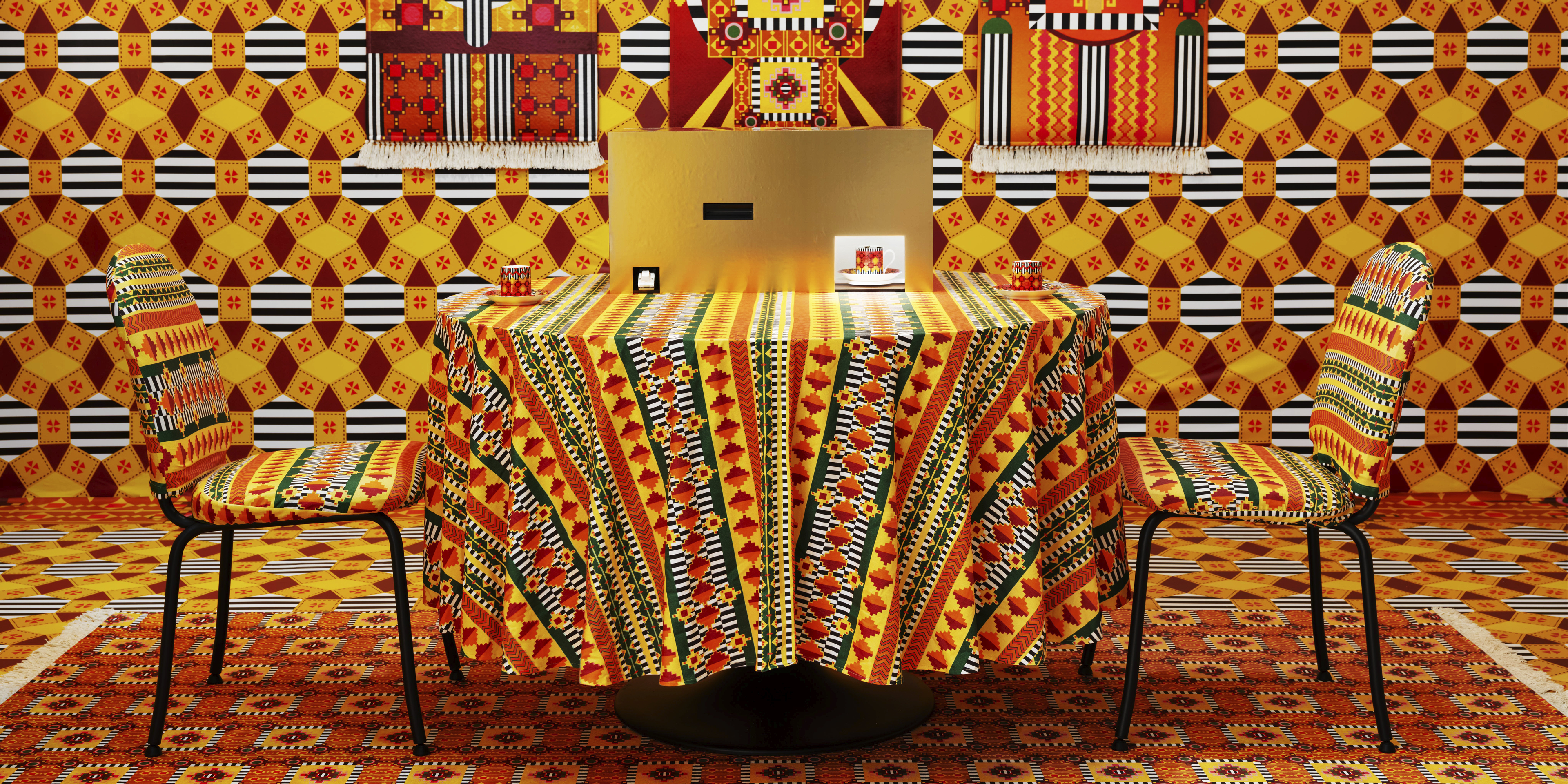
Rethinking the “A” in A.I. as “Ancestral” instead of “Artificial,” Mashinka Firunts Hakopian looks to her Armenian roots. Training an A.I. in the art of tasseography divination through the reading of tea leaves or coffee grounds) with One Who Looks at the Cup: Querent / Բաժակ նայող, 2024-2026, Hakopian and her collaborators – Dahlia Elsayed, Andrew Demirjian, and Danny Snelson – invite museum visitors to have their coffee grounds read by A.I and to think about who is shaping A.I. and with what kind of intelligence and biases. The large language model for the A.I. in the work includes Armenian poetry, oral histories, and transcripts of coffee readings by the artist for SWANA Diasporans. The installation is set in a futurist kitchen, furnished with wallpaper, rugs, and textiles based on traditional Armenian designs combined with digital design elements.. This traditionally feminine space, a site for the sharing of coffee and spiritual knowledge passed down through generations of women, challenges the male-dominated tech sphere. Designed so that its computational technology runs on a small local device, the installation also addresses – and mitigates – the energy consumption and growing environmental impact of A.I. use. Each prediction consumes roughly 10% of the power needed to heat a small cup of coffee.
Pelenakeke Brown‘s new work Reverb, 2025–2026 looks to ancestral teachings and ruminates on the relationality between past and present. Combining traditional Samoan tapa cloth-making and Crip Theory, the artist traveled with her mother to their ancestral village to learn the art of tapa-making and to create large-scale cloths made from mulberry bark which were then printed. Brown uses digital and screenprinting technologies and the language of the computer keyboard to share Samoan stories in the visual languages of tatau (tattooing) and siapo, both of which the artist frames as indigenous writing. The indents and >>> marks reference vae tuli (bird footprints), which are found in both tatau and siapo (Samoan painting on tapa). In the story of how Samoa was formed, a bird (the tuli) lands and an island springs forth. The IXI marks are based on the scissor switch mechanism underneath the keys on a keyboard which are similar to traditional tatau and siapo markings. In Reverb, they reference the earthquake god sitting under the surface connected by a pillar that shakes. Audio recordings of the beating of the bark to make the tapa will be incorporated into the installation.
In the film installation, Speculations on Capture, 2024, Morehshin Allahyari documents technological developments in Iran from astrolabes to the telegraph and the camera, that were co-opted by colonial agendas. Allahyari imagines an alternative future through the return of the earliest astrological technologies to the peoples and cultures that created them, from European museums like the Victoria and Albert Museum which have long held these instruments. This work asserts that knowledge — particularly astronomical knowledge and related technological innovations — were developed in the Middle East and North Africa region long before colonial intervention, and symbolizes the intersection of decolonial and feminist resistance past and present.
Roopa Vasudevan’s Requiem for the Early Internet, 2022/2026, looks back to the internet as the artist experienced it in her youth, contrasting it with today’s web . Referencing historical plaques, the series commemorates – and eulogizes – digital spaces and tools from the 1990s and 2000s that have largely disappeared with the dominance of giant Tech monopolies. QR codes take viewers to web pages that use or recreate the interfaces of sites like Geocities and MySpace to reflect on their importance and what we may have discarded too soon. More than a nostalgic gesture, Vasudevan, “captures the optimism of our online past,” in her words, “ in hopes that it will enable us to imagine” — and create — better possibilities for its future. Her series of 100 hand-drawn QR (Quick Response) codes, titled Slow Response I ( Drawings), 2021-2022 questions the speed and instant gratification associated with technology and our quick adoption of new technologies — and even their failures — while asking how interchangeable human and digital labor is or isn’t.
Neema Githere invites us into rest by bringing her ongoing Data Healing Recovery Clinic into physical space for the first time as part of the exhibition. Conceived as a ritual space for repairing the psychosomatic toll of data trauma, this work references materials such as copper, water, and clay to invoke a lineage of African Indigenous wellness techne as ingredients towards repair. Drawing formal and philosophical inspiration from the Bakongo cosmogram, the installation is organized around a circular altar-structure that mirrors the liminal axis between spiritual and material worlds, known as the Kalunga Line. Titled Nikisi Net, 2026, two hammocks invite visitors to sit and contemplate the relationships they have to their devices and to A.I. while situating contemporary technology within a long history of exploitation. The installation features a durational exchange between the artist and their A.I. “Nkisi”: a re-imagining of ChatGPT as mimicry-oracle and poetic counter-intelligence. These dialogues surface the emotional and ceremonial dimensions of human–machine entanglement, complicating a dominant narrative of artificial intelligence as a neutral tool or static capitalist commodity.
Kite’s multimedia installation Wičháȟpi Wóihaŋbleya (Dreamlike Star), 2024 illustrates the artist’s relational approach to technology through Lakȟóta ontology and ethics. This work grew out of the artist’s translations of her dreams into a Lakȟóta visual language. Geometric forms, often used in women’s quilting, are at the center of a video projection shimmering with images of earth, water, stones, stars, and sky. Doubled in a mirror below, these visions create an interconnected universe that is accompanied by a constellation of stones that serves as a score. The orchestral composition responds to the relationships between land, cosmos, human, and non-human. In a 2018 essay Making Kin with Machines, Kite wrote: “Stones are considered ancestors… stones speak through and to humans, stones see and know. The agency of stones connects directly to the question of A.I., as the technology is formed not only from code, but from materials of the earth. To remove the concept of A.I. from its materiality is to sever this connection. In forming a relationship to A.I., we form a relationship to the mines and the stones.”
Amidst this collection of works is a series of online projects and resources presented on multiple monitors that share information and strategies for change and resistance, including We Refuse, We Want, We Commit: Manifestos for Creative Resistance in Technology, by Vasudevan et al, and Indigenous Protocol and Artificial Intelligence by Lewis et al, Mimi Onuoha’s People’s Guide to A.I., and numerous others.
Technologies of Relation is accompanied by public programming that empowers audiences to interact with digital technology as an active participant, and connect traditions of making globally with digital tools. It will be augmented by a series of workshops and performances that make digital technologies more accessible, cultivating an understanding of the ways we can impact the future of technology, including:
- A conversation on ancient technological futures with exhibiting artists, on February 21 at 4pm.
- A lecture performance by Taeyoon Choi with scholar and programmer Alexander R. Galloway in November 2026 that fuses a lecture with moments of collective engagement to examine the artistic and political significance of what cannot be computed.
- Data-healing programming with artist Neema Githere’s installation as a way to cope with the trauma that social media and online exchanges can cause.
About MASS MoCA
MASS MoCA is one of the world’s liveliest centers for making and enjoying today’s most evocative art, and is an indispensable home for artists who stretch toward what has yet to be created. From its beginnings as the major textile mill Arnold Print Works in the mid-19th century, to its days as the Sprague Electric Company in the mid-20th century, to its current iteration as a globally renowned contemporary art museum and fabrication center, the 24-acre MASS MoCA campus has a rich history of serving as an economic engine of the city of North Adams and the surrounding region. With vast galleries and a stunning variety of indoor and outdoor performing arts venues, MASS MoCA is able to embrace art in all forms. For more information visit massmoca.org or follow on Instagram at @massmoca.
Support for Technologies of Relation is provided by the Jacques and Natasha Gelman Foundation and The Coby Foundation, and a grant from Berkshire Taconic Community Foundation’s Artist’s Resource Trust.
For more information, please contact:
Jennifer Falk
Director of Communications and Content
MASS MoCA
press@massmoca.org
Kim Donica
kd@kimdonica.com