
Spatial Poems Lola Ayisha Ogbara: Scars Insist on Being Remembered
- On view May 23, 2026
- Building 4.1
Lola Ayisha Ogbara: Scars Insist on Being Remembered is an exercise in care that explores Black movement, veneration, and sonic experimentation, presented through imagined geographies and naturally forming archives rooted in the artistic and cultural traditions of post-structuralism in Black American and African diasporic communities. With a conceptual practice standing at the intersection of non-Western epistemologies and bodily topographies, Ogbara explores the philosophical poetics of the scar as both a visual language of fugitivity and an imprint of resistance through material and compositional investigations.
Ogbara’s interdisciplinary practice is built on four cornerstones: texture, form, color, and sound. With a deep interest in materiality, Ogbara works in ceramics, metal, sound, and scent to explore shared knowledge systems and internal archives. She pays homage to and mines dual diasporic identities with cultural nods and allegories, further imbuing intimacy and symbolism into her work.
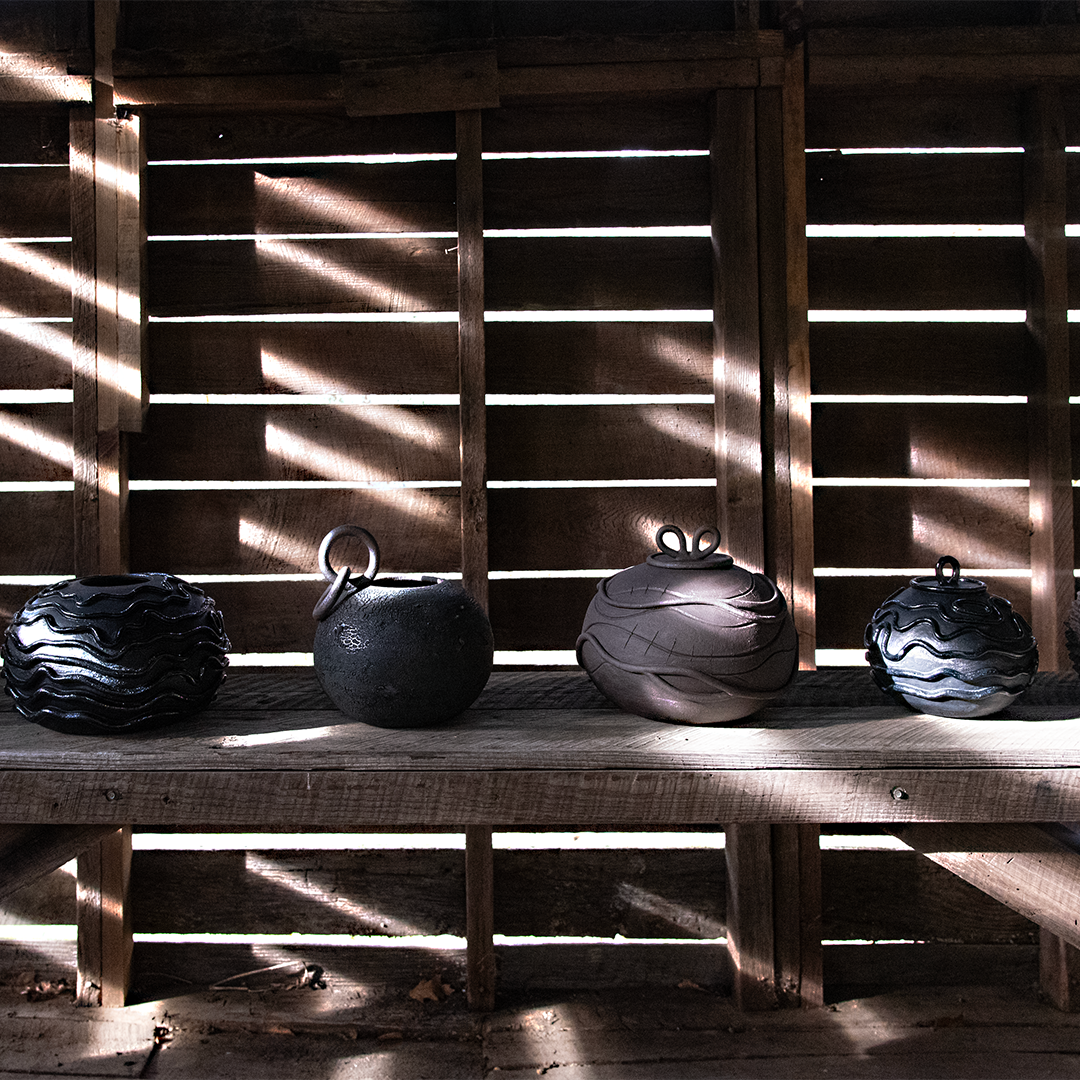
Full of form and shape, the exhibition presents new ceramic works by Ogbara, as well as a commission for a MASS MoCA installation that emulates a drawing from the visual language of 18th-century African American cemeteries. This new installation offers venetration of grave adornments to serve as protective amulets for safe passage, acting as both marker and headstone. Ogbara’s Sticky series (2025) recalls the 19th-century folktale “Tar Baby,” as told in the Uncle Remus stories. It considers the tale as an allegory of Black survival through subversive wit, in which cunning and flight become strategies of endurance. Made of porcelain with glaze, enamel, black sand, and birch, Sticky invokes the legacy of Afrocartography—from the Indigenous Lukala maps of the Democratic Republic of the Congo to the woven routes embedded in braids and quilts throughout the African diaspora in America. Reflecting on these tactics of evasion as a dual narrative of movement and displacement, Ogbara creates her own semiotic map-making language to guide viewers through her personal history while speculating on a path forward.
Central to the presentation, both in quantity and concept, is the series Forget-Me-Knot (2023-2025). These irregular, multi-hued ceramic orbs explore the visual anatomies of keloids, irregular fibrous tissue formed at the site of a wound, rooted in the African practice of decorative scarification, a technique of cutting the skin and guiding its healing to produce raised, patterned forms, and divination tools used in practices of traditional African religions. Creating a near-illusion of woven patches resting on the orbs, clusters of keloids symbolize scars created through lived experience, bodily cartography, and acts of resistance and rest. Ogbara invents her own form of memoriam, marked by traces of the scar itself, honoring its insistence on being remembered across all temporalities.
About the Artist:
Lola Ayisha Ogbara is a Nigerian American conceptual artist from Chicago, Illinois. Her practice explores the haptic sub/conscious, racialized voyeurism, and transcendental sonic experiments. Ogbara has exhibited in art spaces nationwide, including Split My Sides, The Luminary, St. Louis, MO (2020); Skin + Masks III, Kavi Gupta + EXPO Chicago, Chicago, IL (2023); Kemper Museum, Fairyland, Mindy Solomon Gallery, Miami, FL (2021); and Kristen Lorello Gallery. She has also received residencies, fellowships, and awards from Alfred University, Arts + Public Life at the University of Chicago, the Coney Family Fund, the Chicago Department of Cultural Affairs & Special Events, and many more. She has earned a BA from Columbia College Chicago and an MFA from Washington University, Sam Fox School of Art and Design in St. Louis, MO.
Spatial Poems is part of MASS MoCA’s Curatorial Exchange Initiative (CEI). The CEI is an exploratory pilot for how contemporary museums work collaboratively with curators and artists, whose diverse practices and knowledge can be exchanged, supported, and deepened. The three-year program invites six curators to realize curatorial projects at MASS MoCA and in the North Adams community. The CEI is generously supported through leadership gifts from Sarah Arison and the Arison Arts Foundation, Michi Jigarjian, Denise Sobel, the Teiger Foundation, and Yukiko and Anders Schroeder. Additional support is provided by the Director’s Catalyst Fund, with generous contributions from Greg and Anne Avis, Kelly and Bill Kaiser, Steve and Lisa Jenks, Bob Gold, and an anonymous donor.