

Spatial Poems Cecilia Vicuña: union of three
- On view May 23, 2026
- Building 4.1
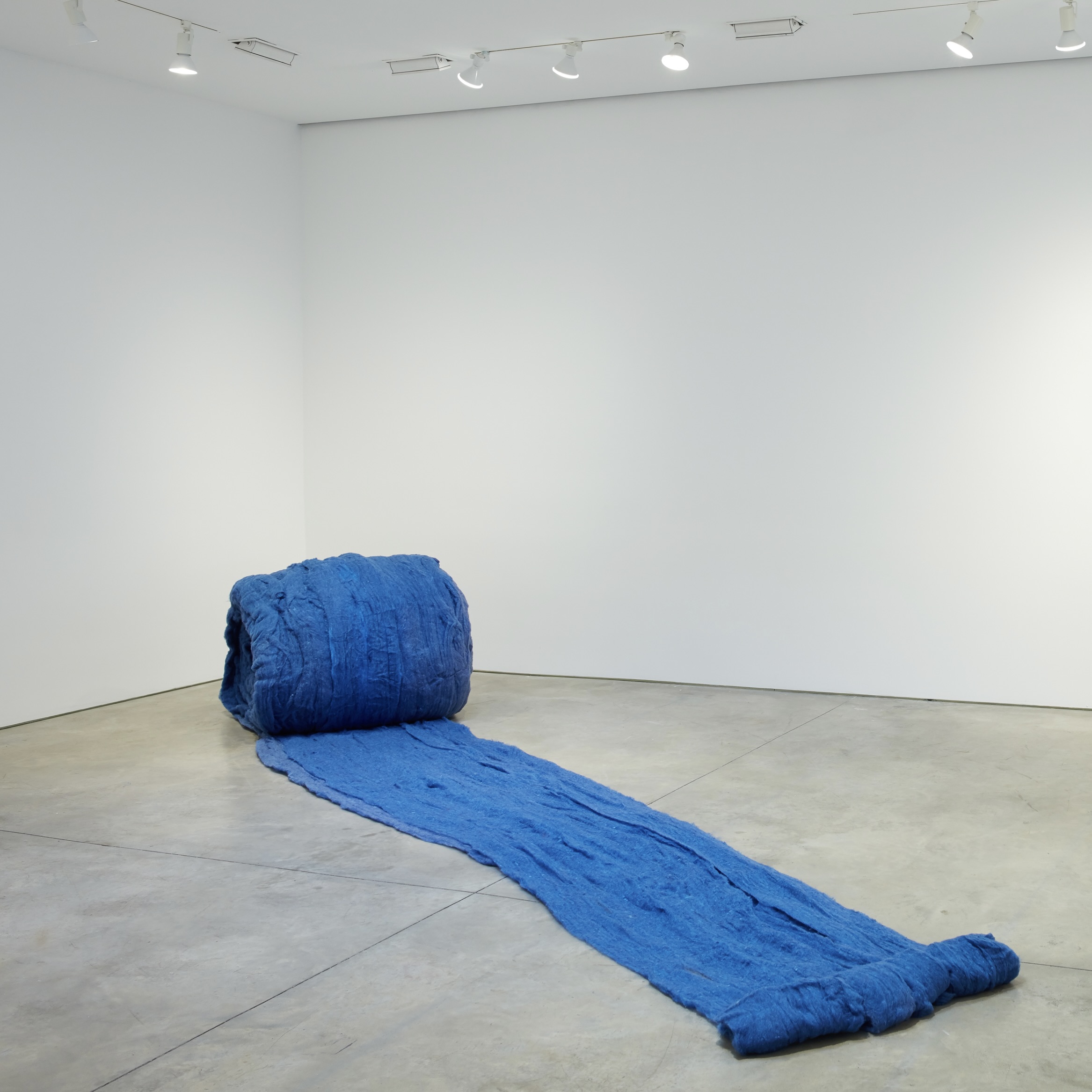
Cecilia Vicuña: union of three is rooted in the artist’s 60-year art practice of ‘precarios’ or ‘Arte Precario’—small assemblages made from discarded and fragmented materials conceptually foregrounded in ephemerality, intangibility, and evanescence. Born in 1948 in Santiago, Chile, and based in New York City, the pioneering visual artist, poet, filmmaker, and activist has focused on various political issues, from the fascist Pinochet era of Chile to the present environmental destruction. Cecilia Vicuña: union of three presents a selection of ‘precario’ and quipu sculptures, including her monumental Quipu Desaparecido 2 / Disappeared Quipu 2 (2018) and Balsa Snake Raft to Escape the Flood (2017), alongside films, texts, and sound.
The core of Cecilia Vicuña: union of three rests in Vicuña’s humble act of ‘precarios,’ where she wove into the wet sand of the beach with sticks and debris in Con cón, Chile. Her physical prayer transformed into evocations of memory and actions of the minutiae, which hold the possibility of what was, is, and could be. Vicuña’s conceptual gesture foregrounded the vulnerability of contemporary political situations through overlooked detritus materials. This action introduced notions of interconnectedness by embracing organic trash forms and revaluing them with meaning.
Much of Vicuña’s practice has channeled Andean epistemology, histories, and knowledge of reciprocal love and wisdom in relation to the environment. Vicuña’s Quipu Desaparecido 2 / Disappeared Quipu 2 (2018), an installation of natural white unspun wool with sound and video, consists of the artist’s chants, poems, and photographic imagery of Andean textiles spanning fourteen hundred years selected by Vicuña from the Brooklyn Museum and Museum of Fine Arts Boston’s Andean textile Collections. This work is part of the series “quipus for the future,” which honors Andean culture and resilience against colonialism. Historically, the quipu was an ancient Andean communication device made of knotted spun string used to record the everyday history, data, and narratives of Indigenous societies. Forbidden and, at times, destroyed by Spanish colonial rule, the quipus persevered in secret as a fugitive act of resistance to colonialism’s domination and violence.
Vicuña’s works offer an alternative mode of thinking apart from the present Western ideology of human domination. Her artworks are sacred offerings, articulations, and evocations of futurity that foreground transmutation and the intimate connection between humans and the cosmos. This spiritual connectivity can only be accessed through a mode of thinking that centers on beauty, harmony, health, and the sacred. This theory of knowledge informs the curatorial premise of her solo exhibition at MASS MoCA.
About the artist
Cecilia Vicuña (b. 1948 in Santiago, Chile; lives and works in New York, NY and Santiago, Chile) integrates practices of poetry, performance, Conceptualism, and textile craft in response to pressing concerns of the modern world, including ecological destruction, human rights, and cultural homogenization. Born and raised in Santiago, she was exiled during the early 1970s after the violent military coup against President Salvador Allende. This sense of impermanence, and a desire to preserve and pay tribute to the indigenous history and culture of Chile, have characterized her work throughout her career.
While living in Chile during the mid-1960s, Vicuña began an ongoing series of small sculptures she calls precarios, spatial poems combining feathers, stone, plastic, wood, wire, shells, cloth, and other human-made detritus. These tiny sculptures are often loosely fastened together with string, so the materials appear to have gathered naturally. These works are defined by their fragility and ephemerality: Vicuña initially composed the precarios along the ocean’s edge, so that they would inevitably be erased by the high tide. Around the same time, Vicuña became interested in ancient quipus—an Andean method of communication and record-keeping involving the knotting of colored strings. Her first spatial weavings date from the early 1970s, and soon after she began to make her own Quipus from unspun wool. These ephemeral, site-specific installations combined the tactile ritual of weaving and spinning with assemblage, poetry, and performance. Vicuña’s surreal figurative paintings of the 1970s are more explicitly personal and political in comparison to her other bodies of work, and were created in direct response to the unrest in Chile and her subsequent exile. These paintings refer to the subtly subversive images made by 16th-century indigenous artists in Latin America after the Spanish conquest, when they were forced to paint angels and saints for the Catholic church. In Vicuña’s paintings, religious icons are replaced by personal, political, and literary figures, commemorated and mythologized by the artist.
Vicuña received her M.F.A. from the National School of Fine Arts, University of Chile in 1971 and continued with postgraduate studies at Slade School of Fine Art, University College London from 1972-1973. Solo exhibitions of her work have been organized at a number of major institutions, including the Pinacoteca do Estado de São Paulo, São Paulo, Brazil (2024); the Perez Art Museum, Miami, FL (2024); Museo Nacional de Bellas Artes, Santiago, Chile (2023); Museo de Arte Latinoamericano de Buenos Aires, Buenos Aires, Argentina (2023); Museum of Contemporary Art, Tucson, AZ (2023); Tate Modern, London, United Kingdom (2022); Solomon R. Guggenheim Museum, New York, NY (2022); Museo de Arte Miguel Urrutia (MAMU), Bogotá, Colombia (2022); Centro de Arte Dos de Mayo (CA2M), Madrid, Spain (2021); CCA Wattis Institute for Contemporary Art, San Francisco, CA (2020); Museo Universitario de Arte Contemporáneo, Mexico City, Mexico (2020); Museum of Contemporary Art North Miami, Miami, FL (2019); Witte de With Center for Contemporary Art, Rotterdam, the Netherlands (2019); Henry Art Gallery, Seattle, WA (2019); Institute of Contemporary Art, Philadelphia, PA (2019); Wexner Center for the Arts, Columbus, OH (2019); Museum of Fine Arts, Boston, MA (2018); Brooklyn Museum, New York, NY (2018); the Berkeley Art Museum and Pacific Film Archive (BAMPFA), Berkeley, CA (2018); Neubauer Collegium, University of Chicago, Chicago, IL (2018); Contemporary Arts Center, New Orleans, LA (2017); Museo de la Memoria y los Derechos Humanos, Santiago, Chile (2014); Museo Nacional de Bellas Artes, Santiago, Chile (2014); Institute for Women and Art, Rutgers University, New Brunswick, NJ (2009); The Drawing Center, New York, NY (2002); and the Boulder Museum of Contemporary Art, Boulder, CO (2002).
Her work is in numerous international private and public collections, including the Berkeley Art Museum and Pacific Film Archive, (BAMPFA), Berkeley, CA; Blanton Museum of Art, University of Texas at Austin, Austin, TX; Cisneros Fontanals Art Foundation, Miami, FL; Cranford Collection, London, United Kingdom; Dallas Museum of Art, Dallas, TX; EMDASH Foundation, Berlin, Germany; Fonds Régional d’Art Contemporain de Lorraine, Metz, France; Guggenheim Abu Dhabi, Abu Dhabi, United Arab Emirates; IVAM – Institut Valencià d’Art Modern, Valencia, Spain; KADIST, Paris, France; San Francisco, CA; Museo de Arte Contemporáneo, Santiago, Chile; Museo de Arte Latinoamericano de Buenos Aires (MALBA), Buenos Aires, Argentina; Museo de Arte de Lima (MALI), Lima, Peru; Museo Nacional Centro de Arte Reina Sofía, Madrid, Spain; Museum of Contemporary Art San Diego (MCASD), San Diego, CA; Museum of Fine Arts, Boston, MA; The Museum of Modern Art, New York, NY; Museum of Modern Art in Warsaw, Warsaw, Poland; Museo Nacional de Bellas Artes, Santiago, Chile; National Portrait Gallery, Smithsonian Institution, Washington, D.C.; Pérez Art Museum Miami (PAMM), Miami, FL; Philadelphia Museum of Art, Philadelphia, PA; Princeton University Art Museum, Princeton, NJ; Solomon R. Guggenheim Museum, New York; Tate Modern, London, United Kingdom; and Zhuzhong Art Museum, Beijing, China.
Spatial Poems is part of MASS MoCA’s Curatorial Exchange Initiative (CEI). The CEI is an exploratory pilot for how contemporary museums work collaboratively with curators and artists, whose diverse practices and knowledge can be exchanged, supported, and deepened. The three-year program invites six curators to realize curatorial projects at MASS MoCA and in the North Adams community. The CEI is generously supported through leadership gifts from Sarah Arison and the Arison Arts Foundation, Michi Jigarjian, Denise Sobel, the Teiger Foundation, and Yukiko and Anders Schroeder. Additional support is provided by the Director’s Catalyst Fund, with generous contributions from Greg and Anne Avis, Kelly and Bill Kaiser, Steve and Lisa Jenks, Bob Gold, and an anonymous donor.