

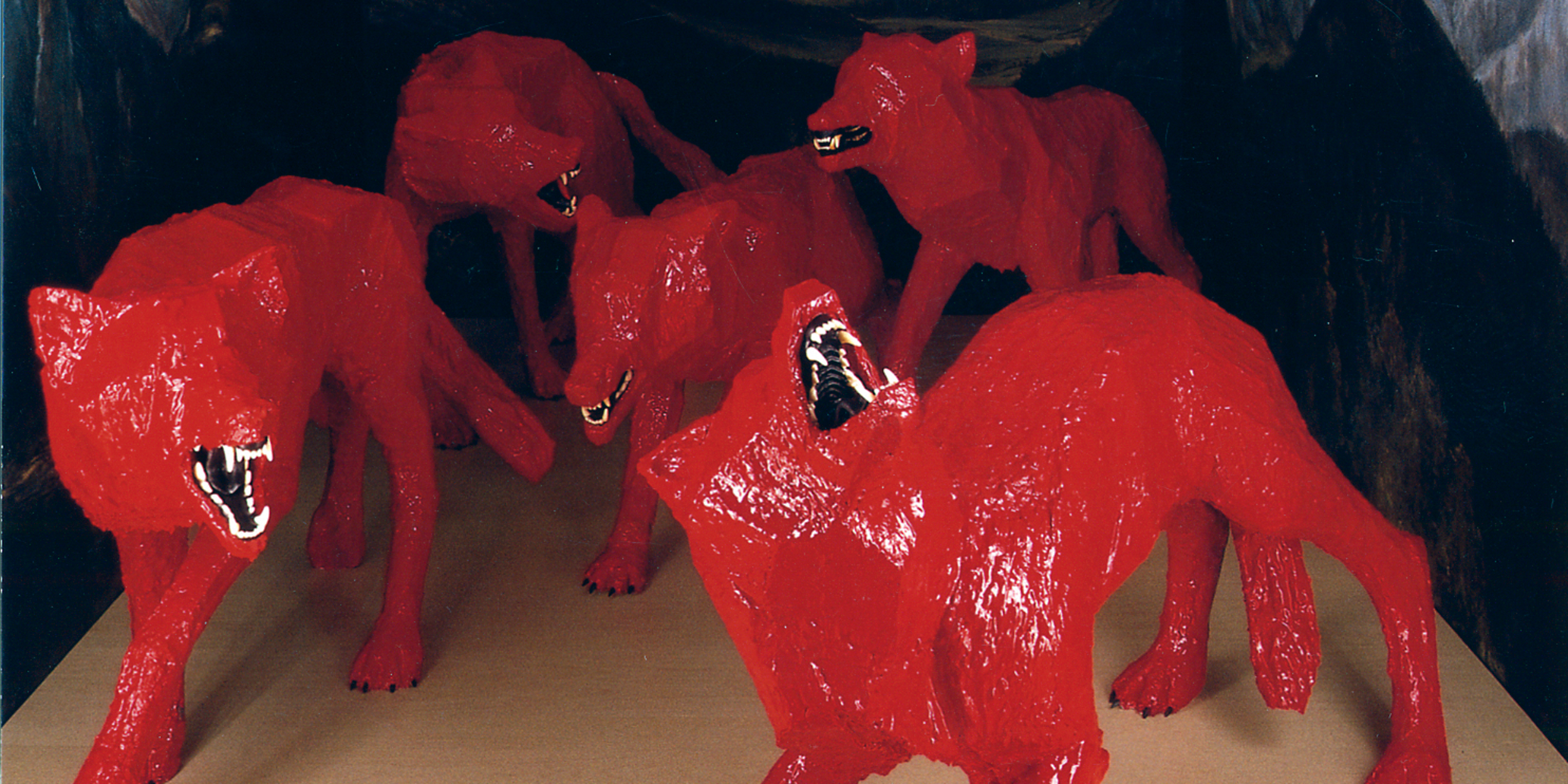

Exhibition
- December 9, 2001 - October 14, 2003
- Building 5
At the heart of Christian theology, the Via Crucis or “Way of the Cross” describes Jesus’ journey of condemnation, consolation, crucifixion, and resurrection in a series of distinct moments in time and space called the 14 Stations. Artists have created condensed processionals for representing the Via Crucis since the 11th century, when the practice became an important part of Christian devotional service. In his interpretation, 14 Stations, American artist Robert Wilson invested the traditional narrative structure with new forms and meanings, combining Shaker design elements with light, space, sound, and sculpture in a universal, sometimes mysterious exploration of human passion and spiritual fortitude.
Early medieval representations of the Stations were simple, each marked by little more than a wooden cross. By the mid-15th century, artists were presenting extremely detailed renditions of the various story elements. The faithful were encouraged to envision Christ’s passions, to assume His sufferings by seeing and imagining the physical and emotional burden of the Cross. In its most vivid form, live stagings of the Via Crucis were presented as grand theatrical pageants, organized by individual churches, religious orders, or entire towns. The famous Passion Play of Oberammergau, Germany — presented every 10 years since 1634 — is perhaps the best known example of this tradition, often attracting over 500,000 visitors worldwide. (Robert Wilson’s 14 Stations was originally commissioned by Oberammergau in conjunction with the Passion Play 2000.)
The number of Stations — and the individual stories and legends depicted within them — varied until the early 18th century, when Pope Clement XII definitively defined the 14 stations, fixing the number at 14. The regulation of the Via Crusis meant that all churches could present a standard storyline, unleashing a wave of new art on the theme, including stained glass windows, illustrated books, and major sculptural programs often presented as an integral part of church architecture. The human facts and the spiritual possibility of the Stations continued to engage artists into the twentieth century. Artists such as Henri Matisse (1869-1954), Barnett Newman (1905-1970), and Francesco Clemente (b.1952) have taken up the theme, often reducing the story to its most abstract, elemental form. Newman did not conceive of his imagery as a series of anecdotes, for example, but rather a unified emotional response to what he viewed as the essence of the 14 Stations, as given in the 22nd Psalm. Newman explained, “Why hast thou forsaken me? Why do you forsake me? To what purpose? Why? That is the Passion. This outcry of Jesus. Not that terrible walk up the Via Dolorasa, but the question that has no answer.”
While Wilson’s version of the 14 Stations followed the traditional religious narrative structure, he also intended the work to be more universal, and open. “My work is an environment, an installation that brings together elements of architecture, theater, sculpture, art, music and language. In a certain sense, it is a mental landscape. Call it an encounter of different cultural traditions — in which I have tried to invent my own language. It is like a mysterious journey that one experiences. If you don’t know anything about Christianity, it’s OK, but if you know something about it, you’ll see it in a different context.”
Wilson’s 14 Stations worked as a processional through space and time, and in plan recalled the architecture of a medieval cathedral. Viewers entered onto the elevated plane of the installation via a gently sloping ramp, entering a low bunker-like transept and then continued down a long nave which was bordered on each side by six chapels, each containing carefully staged audiovisual vignettes. Although the overall scale of 14 Stations was grand, the effect was intensely focused and personal: only one viewer at a time could peer into the small front windows of the house-chapels, which might recall tableaux vivants. Anchoring the long aisle, an apse of trees formed a soaring vertical gothic arch. If the floor plan referred to ecclesiastical architecture, such architecture also had a human analogue: the low Station #1 represented the base, or foot; the boardwalk-nave the body; the soaring apse the head, or realm of the spirit. “One thing helps you see another,” noted Wilson. “I always work with a horizontal line, which stands for time, and a vertical line, which, for me, always means space. This is something personal; the timeline goes towards earth or heaven. Time and space are two crossing lines, a structure that forms the architecture of everything.”
If Wilson abstracted the 14 Stations, removing most vestiges of conventional Christian iconography, he also augmented them with visual and sonic imagery from other sources. The mundane sounds of a pencil dropping became infused and conflated with the wood of the cross, and the falls of Christ on His way to the Crucifixion. The very weight of the cross itself might have been inferred from the repetitive use of huge granite boulders, miraculously suspended. “The stone has many meanings,” Wilson said. “It can be an image of death, age or resurrection. When a rock is flying this is something light, but something you fear, something heavy, but weightless — There is always a duality, heaven cannot exist without hell. It is not two bodies, but one.” Shaker architecture and furniture design were a strong presence throughout 14 Stations, the pared-down, severe aesthetic and sense of proportion always informed Wilson’s own. The overlapping and cross-referencing of imagery from an ascetic New England sect with that of the liturgically rich Catholic church spoke to the elasticity and unexpected potentiality of the traditional narrative in the hands of an artist. Some critics have also speculated that Wilson’s sometimes stark rendering of the Stations makes reference to concentration camp architecture, conflating the Germany of Passion Plays with that of the Holocaust. From that viewpoint, the portrayals of condemnation, suffering, and solace are universalized, but also given a specific geopolitical meaning and grounded in a tragic historical context.
The overall coolness of the installation, the geometric simplicity, the remote, frozen quality of Wilson’s faceless figures, and the stately pace of the presentation all had a crystallizing effect on what might have otherwise overwhelmed us as viewers. In the end, there was a clear, measured quality to the passions of Wilson’s 14 Stations, which made them resonate all the more powerfully in the present.
14 Stations was accompanied by a group of Wilson’s drawings, which presented several of his theatrical works, a small group of photographs and sketches that documented the genesis of 14 Stations, and a group of chairs designed by Wilson, for which he is best known as a visual artist. A 28-minute film by Wilson, Deaf Man Glance, was also screened.
Special thanks to the Mayor of Oberammergau for his generous assistance. Goethe-Institut Inter Nationes Boston provided partial funding. Adams Plumbing and Heating provided in-kind support. Many artists and artisans participated in the original fabrication of 14 Stations, and these are acknowledged in the exhibition catalog. At MASS MoCA, Richard Criddle organized the re-fabrication. Larry Smallwood provided lighting and sound design in consultation with Peter Cerone (who also created the original soundtrack). Among the many others who provided skills and ideas, William Taft and Bigs Waterman provided construction expertise, Deborah Coombs provided scenic painting, Michael Chapman, John Carli, and Chris Fleming were lead preparators, Willard Greenwald provided electro-mechanical magic, Adams Plumbing and Heating fabricated the blood well, H.L. Chesbro & Son did heavy lifting, and Sally Plass made the blue bird.
Station 12. Lesley Leslie-Spinks